
2008-01-30


2008-01-26
"Covenant and Salvation" - a Review
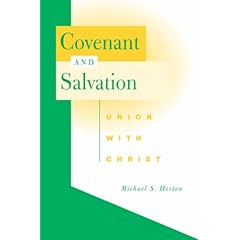 This is one of the most aware and hopeful accounts of Reformation Theology that the reader will ever see. It is incredibly relevant to the current world of theology. Horton begins with the presupposition not only that “the Reformation tradition” contains a huge amount of “unexploited potential” for engaging this current world, but that this potential is found within the framework of Covenant Theology.
 Horton traces the two covenants, “the covenant of Law,” given to (and broken by) both Adam and Israel, and the “covenant of Promise,” given to Noah, Abraham, David, and ultimately fulfilled in Christ. He distinguishes these two covenants, based on research done not only by Reformed biblical scholarship, but also “from Jewish and Roman Catholic traditions” (including the work of Cardinal Joseph Ratzinger) that has found two ancient kinds of covenants: a “suzerainty” treat, often given from a stronger king to a weaker king in the form, “do this and you will live,” and a covenant of Promise, given in the form of “a royal grant,” which took the form of “an outright gift of a king to a subject.”
“The covenant at Sinai certainly bears the marks of a suzerainty treaty. In fact, the exact form is followed in Exodus 19 and 20 as well as in Deuteronomy 5: Yahweh identifies himself as the suzerain (preamble), with a brief historical prologue citing his deliverance of the people from Egypt, followed by the Ten Commandments (stipulations), with clear warnings (sanctions) about violating the treaty to which they have sworn their allegiance.” (pg 13.)
The covenant with Noah, Abraham and David is given in “a completely different form,” a “one-sided promise on God’s part with no conditions attached (see Genesis 9). “The point is this: the deepest distinction in Scripture is not between the Old and New Testaments, but between the covenants of law and the covenants of promise that run through both” (pg 17, emphasis in original).
From this point, Horton engages all of the many theologies that are being presented today, beginning with the “New Perspective on Paul,” (the “covenant nomism” of which takes into account the covenant of Law, but not the covenant of Promise,” but along the way, he engages not only Sanders, Dunn and Wright, but also Rahner and Von Balthasar, Barth and Hunsigner, Milbank and Ward, Tillich, Moltmann, and a host of others. Along the way, Horton brings home with power and dignity the genius of the Reformers, and he shows how the genius of the Reformers is not only relevant in today’s thought climate, but ideal.
This is a thoughtful, erudite, and masterful work.
2008-01-17
Whose version of the Bible is right?
Catholic Bibles have 72 books as all good school children learned in my day. The Protestant Bibles have 66. Who's right? And who should we believe about who's right?
Consider this short snippet (it's about 6 minutes long, with a little bit of audio, and mostly some pretty music):
Consider this short snippet (it's about 6 minutes long, with a little bit of audio, and mostly some pretty music):
Clark's Review of "A Secular Faith"
"A Secular Faith: Why Christianity Favors the Separation of Church and State" by D.G. Hart -- a Review by R. Scott Clark
Permissions: You are permitted and encouraged to reproduce and distribute this material in any format provided that you do not alter the wording in any way, you do not charge a fee beyond the cost of reproduction, and you do not make more than 500 physical copies. For web posting, a link to this document on our website is preferred. Any exceptions to the above must be explicitly approved by Modern Reformation.
Evangelical involvement in politics has perhaps never been more intense. The Bush administration speaks of integrating faith and politics and has an office of faith-based initiatives. The national media cover the scandals of evangelical leaders because those evangelicals have political clout. Indeed, most Christians on the right and left seem to agree that there is such a thing as distinctly Christian politics. Into this super-heated environment comes a book by Darryl Hart challenging the assumptions that fuel the social programs of both conservative and liberal Christians.Modern Reformation magazine, March/April Vol. 16 No. 2 2007 Pages 49-51
Hart's argument with both groups is that "Christianity in its classic formulations, especially the Protestant traditions of Lutheran, Reformed, and Anglican, has very little to say about politics or the ordering of society" (10). "Christian-inspired policy arguments" or candidates are inappropriate "on Christian grounds" because "using Christianity for political ends fundamentally misconstrues the Christian religion" (253).
Through nine chapters, Hart interacts with a substantial body of literature attempting to account for the relations between Christ and Caesar. He argues that, when pressed into the service of Caesar, Christianity is always denatured and cheapened, because, the "trick of successfully employing any faith for public ends is to have access to the socially useful parts of religion while leaving behind its dogmatic and sectarian baggage" (13). For Hart, there is no such thing as "Christian" politics. For readers familiar with Hart's earlier work, this view should come as no surprise as it is part of his broader advocacy of the renewal and reapplication of the Reformation theory of the two kingdoms, that is, the notion that Christ is sovereign over all things but he administers his sovereignty in two distinct kingdoms: civil and ecclesiastical. Thus, nonecclesiastical vocations are common to believers and unbelievers and much of this common work must be conducted according to creational categories (nature) and existing cultural norms rather than redemptive categories (grace). In other words, there is no distinctly Christian way to drive a bus or set monetary policy. Bus drivers, historians, and politicians do common work according to nature. Hart, with a few other writers (such as David VanDrunen and Michael Horton), seeks to employ the two kingdoms theory in the late modern world as a bulwark against evangelical and liberal theocratic tendencies. According to Hart, both the evangelical right and the mainline left are theocratic. Walter Rauschenbusch's "social gospel" has become the playbook for ostensibly conservative evangelicals (105-123). Both the Christian left and right routinely misappropriate and misapply passages from the Old Testament-passages intended to speak to the Israelite theocracy and to the church-as if they were intended to serve as a blueprint for post-canonical social policy.
How are Christians to negotiate their civic lives? Hart's answer is that we must embrace an "awkward neutrality" (229-230), that we must be prepared to live "hyphenated lives." With "legal secularists," Hart argues that for Christian secularists, "the work of government lacks any overtly religious or spiritual purpose" (15). Its work is common to believer and unbeliever. In an age when the "integration" of faith and life is the standing order, it is bracing, even shocking to see one arguing that Christians should "bracket" their faith (175-177, 253, 257) from their civic lives.
He takes issue with the notion on which much Christian political involvement has been premised, , American exceptionalism, the notion that the United States is a "shining city on a hill" (19-45). Only the visible church could be that city in this world. Thus, he criticizes the colonial Puritans, mainline Christians, and evangelicals for consistently applying theocratic categories to the civil rather than to the ecclesiastical kingdom.
Following George Marsden's account of the influence of the "Whig cultural ideal" (54), Hart observes that Christians have regularly confused democratic republicanism with Christianity and vice versa, conflating Christian liberty with political liberty (66). He argues that the legal secularism of Isaac Kranmick and R. Laurence Moore is closer to the intent of the Westminster Divines than is modern Christian republicanism (69-71). He chronicles the consequences of this ideology for American Christianity by surveying the rise of the "common" (public) school. In order for such an institution to foster a generic civic religion, the common schools that arose in the 19th century had to promulgate a sub-Christian faith (89).
Drawing upon Nathan Hatch's analysis of the democratization of American Christianity, Hart also contends that much of what is done in the name of advancing the "kingdom of God" is really the product of Jacksonian, egalitarianism (124-152), and attempts to preserve the Protestant hegemony, on the flawed assumption that the Protestant churches are the seminary of democracy (145, 150-152).
One of the most interesting chapters is his survey of the changes in religious identity in America from Al Smith's defeat to today. John Kennedy had to assure evangelicals that he would not allow his Romanism to influence his policies and today evangelicals seem to insist that Roman politicians obey the Pope in their civil lives. In this chapter, Hart engages in his most detailed biblically based argument (170-174) for the two-kingdoms reading of Scripture.
Rejecting the dominant two-party reading of American religious history, that is, that there are two kinds of Christians ("conservative" and "liberal"), Hart argues that the conservatives of the National Association of Evangelicals are not really different from liberals of the National Council of Churches (chapter 7). Rather, genuine religious faith is bound not to produce a religious unity, as the Christian-republicans (right and left) imagine, but division. True religious conviction is inherently confessional and sectarian (206).
Like everything that Hart writes, this work is provocative in the best sense. As a Reformed confessionalist, I find his argument theologically compelling. The Israelite theocracy was unique and fulfilled by Christ. Christ and his apostles established an institution with only spiritual authority and commanded Christians to live peaceably and patiently in a hostile culture. Implicitly or explicitly, however, under the influence of pre- or post-millenarian eschatology (anticipating some earthly golden age) Christians have spent much of modernity trying to resuscitate Christendom by employing implicitly or explicitly theocratic arguments. Even if one disagrees with Hart's theology, anyone willing to reconsider the prevailing theology of cultural engagement will find a vigorous discussion partner here.
My agreement notwithstanding, Hart's rhetoric and historical analysis raise questions for further discussion. According to Hart, the adjective "public" refers to civic activities and the adjective "private" refers to sectarian ecclesiastical religious activities. [Certainly he is entitled to his definitions, and used to mean "not civic," Christian practice must be described as private. Yet some will wonder whether "private" is the best adjective to describe Christian theology and practice.] It's true that certain acts of piety are to be private (176) in the sense of "hidden from view" (Matt. 6:4), but the empty tomb was available for everyone to see, as was Christ's resurrected body and as is Christian worship.
Historians may balk at a few characterizations of seventeenth-century British politics and the political intentions of the Westminster Assembly (e.g., 64, 70). For example, though Hart concedes that the two kingdoms doctrine emerged under Christendom (i.e., a state-church, the civil enforcement of the first table of the Decalogue), his account of Westminster Confession of Faith chapter 20 makes no mention of the original version of Article 23, which calls for the magistrate to keep "unity and peace" in the church and to keep pure "the Truth of God" and to suppress "all blasphemies and heresies" (23.3).
Similarly, his claim that the Reformation marginalized the institutional church (244) is partly true, but a little misleading. He refers in passing to the consequence of desacralization of the world by the Reformation. Where the medieval church had grace "perfecting" nature, the Reformation restored nature and grace to their rightful places. For Protestants, grace renews nature. Did that make the church less or more important in the lives of believers?
One might also be puzzled by the relative absence of Calvin's theory of the two kingdoms in a book by a confessional Presbyterian. He spends several pages on Augustine's two cities and on Luther's theory of the two kingdoms but little on Calvin's theory of the two kingdoms, giving perhaps unintentionally the impression that his view is more Augustinian and Lutheran than Calvinist.
Finally, Hart's argument makes one eager for further elaboration of a positive basis on which Christians can make civil decisions. After all, through the ballot initiative and referendum process now commonplace, the average citizen is engaged in making policy on a level that pre-Enlightenment Christians could hardly imagine. Discussion of the historic Protestant doctrine of natural law will be most welcome. This is a valuable book deserving of careful attention from readers across the religious and theological continuum.
Permissions: You are permitted and encouraged to reproduce and distribute this material in any format provided that you do not alter the wording in any way, you do not charge a fee beyond the cost of reproduction, and you do not make more than 500 physical copies. For web posting, a link to this document on our website is preferred. Any exceptions to the above must be explicitly approved by Modern Reformation.
2008-01-13
Triablogue: Theology at sea
Triablogue: Theology at sea or, "How the Catholic Church's Foundations are Crumbling."
How the internet can break an impenetrable edifice
It turns out that even the Mafia is being "transformed" by the internet.
That's because so much of Catholic "authority" -- especially the papacy -- has been "built on sand." The internet -- representing a flood of information, including a way of disseminating more accurate information about the papacy's history -- is going to erode away the foundations of that house built on sand.
PALERMO, Sicily (Jan. 13) - When it came down to business, Cosa Nostra could always count on fear. No more. In a rebellion shaking the Sicilian Mafia to its centuries-old roots, businesses are joining forces in refusing to submit to demands for protection money called "pizzo."The concept is different, but I think that the fear which held much of Catholicism in place -- the mystique of their authority -- is likewise being dissipated by people who are no longer dependent largely on their parish priests to get a handle on what their Church really teaches.
And they're getting away with it, threatening to sap an already weakened crime syndicate of one of its steadiest sources of revenue. The Mafia has a history of bouncing back from defeat, but this time it is up against something entirely new: a Web site where businessmen are finding safety in numbers to say no to the mob.
At the same time, businessmen ranging from neighborhood shopkeepers to industrialists are being emboldened by arrests of fugitive bosses, and the discovery in raids of meticulous Mafia bookkeeping on who paid the "pizzo" and how much.
"This rebellion goes to the heart of the Mafia," said Palermo prosecutor Maurizio De Lucia, who has investigated extortion cases for years. "If it works, we will have a great advantage in the fight against the Mafia."
These latest gains build on other successes in the fight to break Cosa Nostra's stranglehold on Sicily. In the last two decades, the syndicate has been battered by testimony from turncoats, who helped send hundreds of mobsters to prison in the late 1980s, and a fierce state crackdown a decade later after bombs killed two Palermo anti-Mafia prosecutors.
The number of rebels on the Web site is still tiny compared to Palermo's businesses overall, but their movement has helped to chip away at the Mafia's psychological hold on Sicilians - long conditioned to believe that defiance would bring ruin or a death sentence. And any consistent crumbling of that culture of fear could ultimately lead to Cosa Nostra's undoing.
That's because so much of Catholic "authority" -- especially the papacy -- has been "built on sand." The internet -- representing a flood of information, including a way of disseminating more accurate information about the papacy's history -- is going to erode away the foundations of that house built on sand.
2008-01-06
Why the Reformation will Succeed Today
As I read the history of the Reformation, little by little, it occurs to me that the ideas and ideals of the Reformation will be more relevant and more successful in our time than in the time when they were first espoused. Today's Protestant churches seem to be wandering in a lot of different directions. The Reformation will enable Protestants, by the mere discussion of its ideals, to be able to re-focus on what is really important in their heritage.
As well, today's Catholic Church is seeking desperately to keep its hold on "the Faithful," but the things which are distinctively Catholic (as opposed to what is genuinely Christian in that religion) will be seen to be more and more bankrupt as more people begin to understand what the Reformation was all about.
Why do I say that? Because in the 16th century, even though ideas could spread via printing and the printing press, there was a mighty and unjust response from the "Catholic Reformation," which I've written about elsewhere, which included such things as repression and persecution and even "wars of religion." Such things are not likely to happen today. The main "religious" responses to the Protestant Reformers came in the form of the Jesuits and their casuistry, (and a blind devotion to the papacy that mandated "the white which I see, is black, if the Hierarchical Church so decides it." In today's internet-connected world, people today are more bound to require to "be convinced by Scripture and reason," and thus, Catholicism will be forced to defend its ideas on their own strength, not with a sword.
And the Catholic response to the Reformation was the Council of Trent,
As well, today's Catholic Church is seeking desperately to keep its hold on "the Faithful," but the things which are distinctively Catholic (as opposed to what is genuinely Christian in that religion) will be seen to be more and more bankrupt as more people begin to understand what the Reformation was all about.
Why do I say that? Because in the 16th century, even though ideas could spread via printing and the printing press, there was a mighty and unjust response from the "Catholic Reformation," which I've written about elsewhere, which included such things as repression and persecution and even "wars of religion." Such things are not likely to happen today. The main "religious" responses to the Protestant Reformers came in the form of the Jesuits and their casuistry, (and a blind devotion to the papacy that mandated "the white which I see, is black, if the Hierarchical Church so decides it." In today's internet-connected world, people today are more bound to require to "be convinced by Scripture and reason," and thus, Catholicism will be forced to defend its ideas on their own strength, not with a sword.
And the Catholic response to the Reformation was the Council of Trent,
which declared its mind, after much heart-searching, on the matter of justification: a decree of sixteen chapters with thirty-three canons attached. Canon Nine reads: "If anyone saith that by faith alone the impious is justified ... let him be anathema." It was entirely due to Luther that Catholicism was now defined in relation to that Doctrine! (Patrick Collinson, "The Reformation: A History," pg 113)
2007-12-22
John Calvin’s Influence in the Church and the World
In selecting the Reformation period as the focus of my effort, I am attracted by such summaries as this overview of what John Calvin and his associates were able to accomplish in the city of Geneva during the mid 1550’s. Remember that this was the time during which the Roman Catholic Church was instituting a period of great repression.
* * * * *
The following is taken from Robert Reymond’s “John Calvin: His Life and Influence” ©2004 Robert Reymond, Christian Focus Publications, Ross-Shire, England, pgs 74 ff.
Calvin’s “second Geneva period” (1541-1564) has been generally divided by his biographers and church historians into two distinct periods: his years of struggle (1541-1555), about which we will say something, in which he was often at odds with the Little Council and with his religious enemies, and his years of triumph (1555-1564). Here again, we witness the Genevan motto, Post Tenebras Lux, being exhibited. Much could be said about Calvin’s ministry during the last nine years of his life when he was finally able to see his concern for a free church in Geneva approved by the Little Council[i] and his energies directed to his writings and to the evangelization of France. But we may summarize his accomplishments during this “Second Geneva Period” by highlighting the following eight categories of activity that he accomplished with eh aid and cooperation of a close band of like-minded ministerial colleagues (“the Venerable Company”), all of whom like himself were exiles from France, and the Consistory a new institution made up of an equal number of ministers and magistrates sitting as elders, that met on a regular basis to supervise the morals and religious life of the community:
Calvin finally saw founded in Geneva, not a new state, but a new church[ii]—the Protestant church. I will explain what I mean here. Abraham Kuyper observes:
…when the question is put, Who had the clearest insight into the reformatory principle, worked it out most fully, and applied it most broadly, history points to the Thinker of Geneva and not to the Hero of Wittenberg. …in all Lutheran countries [following the principle of Luther and the Lutheran jurists: Cuius region eius religio (“Whose the region, his the religion”)] the Reformation originated from the princes rather than from the people, and thereby passed under the power of the magistrate, who took his stand in the Church officially as her highest Bishop, and therefore was unable to change either the social or the political life in accordance with its principles.
Calvin’s “ideal of a Church, not independent of the State, but autonomous and free to act in its own sphere, came into conflict at every instant with the strict dependency to which the German Churches were subjected by the political power.” Consequently, the churches following Calvin’s lead in Switzerland, the Netherlands, England, Scotland, and Colonial America—fearing with Calvin the “annexation of the church by the state, a secularization of [its] theology for the benefit of political ideology, [and] the dilution, finally, of the ecclesiastical dignity within the civil hierarchy”—insisted upon freedom from the powers of the magistrate insisted upon freedom from the powers of the magistrate in order to govern themselves, thereby creating the Protestant Church. And these Calvinistic churches:
* * * * *
In all, Reymond noted that there were eight accomplishments, and I have noted the first two of those here. It’s true that these were largely political accomplishments. But given the atmosphere at the time, and how both the papacy and secular kings sought each to dominate the other, and to meddle in the affairs of others, this “separation” by Calvin at Geneva was a remarkable concept in the history of the church.
This “separation” of the church from under the influence of the government, while enabling Christians to influence the governments of the time, also enabled the church truly to be the church in the world.
Other accomplishments included:
* The Geneva Bible in its (original) French translation
* Missionaries to France, and the growth of the French Protestant Churches to a membership of more than two million people
* The Geneva Academy, which became the first Protestant “university”
* More than 4,000 sermons
* Commentaries on most of the Bible, plus three catechisms, several confessions of faith, and many theological treatises
* The Institutes of the Christian Religion
All of these accomplishments helped to generate the “mighty impulse to every forward movement, and made Protestantism the chief propelling force in the history of modern civilization” that Philip Schaff wrote about in his History of the Christian Church.
It is not my contention that “we need another Reformation”. It is my contention that by remembering the original Reformation, that Protestant Christians can:
* Find a point of unity in seeing a common heritage in the theological abuses that the original Reformers sought to reform
* Open a discussion about what the church truly can be in the world, and the great things that Christ has accomplished through a faithful church
* Gain a better understanding of their place in history today
* Give an impulse to the forward movements of our day
No doubt, some will point to the corruptions that have happened among the Protestant churches in light of things like the development of Arminianism, American revivalism, theological liberalism, and other ills. None of these developments, though, should take away the absolute courage and devotion to Christ and the overall success that Calvin and his associates exhibited, which mightily changed the course of history.
--------------------------------------------------------------------------------
Footnotes:
[i] “A brief word about Geneva’s government structure at this juncture may be helpful. At the head of the city’s government was the twenty-five-man Little Council, composed of four powerful magistrates or mayors known as the Syndics, the city treasurer, and twenty others. The Council of the Two Hundred, established in 1527, and elected by the Little Council, somewhat strangely elected in turn those sitting on the Little Council. Between these two Councils was the rather useless Council of the Sixty … whose function was mainly diplomatic … Any business went first to the Little Council, then to the Council of the Two Hundred. A fourth council—the General Council composed of all the heads of households in Geneva—played a more tenuous role; in Calvin’s time it met twice annually: in February to elect the four Syndics and in November to set corn and wine prices. This little arrangement appears to be somewhat cumbersome, but the Little Council members, sitting three times a week, actually wielded the greatest power and in fact ran the city government. So, in sum, that was the magisterial system with which Calvin worked throughout his years at Geneva.” Reymond, pgs 58-59.
[ii] “The central issue that brought this about, as we have suggested, was Calvin’s years-long concern to achieve for the church freedom from the state in ecclesiastical disciplinary matters.” Reymond, pg 75. Again, keep in mind that Rome’s Inquisition was still very much in effect at this time.
* * * * *
The following is taken from Robert Reymond’s “John Calvin: His Life and Influence” ©2004 Robert Reymond, Christian Focus Publications, Ross-Shire, England, pgs 74 ff.
Calvin’s “second Geneva period” (1541-1564) has been generally divided by his biographers and church historians into two distinct periods: his years of struggle (1541-1555), about which we will say something, in which he was often at odds with the Little Council and with his religious enemies, and his years of triumph (1555-1564). Here again, we witness the Genevan motto, Post Tenebras Lux, being exhibited. Much could be said about Calvin’s ministry during the last nine years of his life when he was finally able to see his concern for a free church in Geneva approved by the Little Council[i] and his energies directed to his writings and to the evangelization of France. But we may summarize his accomplishments during this “Second Geneva Period” by highlighting the following eight categories of activity that he accomplished with eh aid and cooperation of a close band of like-minded ministerial colleagues (“the Venerable Company”), all of whom like himself were exiles from France, and the Consistory a new institution made up of an equal number of ministers and magistrates sitting as elders, that met on a regular basis to supervise the morals and religious life of the community:
As a result of the struggles and labors of Calvin and the other Geneva ministers the city’s moral and social bearing gradually improved, which influenced many other cities in Europe and saw Geneva as attempting to live out the principles of religious reform. For these cities, Geneva, emerging as the major powerhouse of religious and cultural reform, became a beacon of hope in an unruly world, so much so that John Knox who studied under Calvin there would later characterize it as “the most perfect school of Christ that ever was on the earth since the days of the Apostles.” Because of Geneva’s reforming efforts, “the moralizing of social life, the work ethic, the prohibition of begging, aid to the poor—these [became] some distinguishing traits of the Calvinistic city.
Calvin finally saw founded in Geneva, not a new state, but a new church[ii]—the Protestant church. I will explain what I mean here. Abraham Kuyper observes:
…when the question is put, Who had the clearest insight into the reformatory principle, worked it out most fully, and applied it most broadly, history points to the Thinker of Geneva and not to the Hero of Wittenberg. …in all Lutheran countries [following the principle of Luther and the Lutheran jurists: Cuius region eius religio (“Whose the region, his the religion”)] the Reformation originated from the princes rather than from the people, and thereby passed under the power of the magistrate, who took his stand in the Church officially as her highest Bishop, and therefore was unable to change either the social or the political life in accordance with its principles.
Calvin’s “ideal of a Church, not independent of the State, but autonomous and free to act in its own sphere, came into conflict at every instant with the strict dependency to which the German Churches were subjected by the political power.” Consequently, the churches following Calvin’s lead in Switzerland, the Netherlands, England, Scotland, and Colonial America—fearing with Calvin the “annexation of the church by the state, a secularization of [its] theology for the benefit of political ideology, [and] the dilution, finally, of the ecclesiastical dignity within the civil hierarchy”—insisted upon freedom from the powers of the magistrate insisted upon freedom from the powers of the magistrate in order to govern themselves, thereby creating the Protestant Church. And these Calvinistic churches:
Have always struggled…for the liberty, that is to say, for the sovereignty of the Church, within her own sphere, in distinction from the Lutheran theologians. In Christ, they contended, the Church has her own King. Her position in the State is not assigned her by the permission of the Government, but jure divino. She has her own organization. She possesses her own office-bearers. And in a similar way she has her own gifts to distinguish truth from the lie. It is therefore her privilege, and not that of the State, to determine her own characteristics as the true Church, and to proclaim her own confession as the confession of the truth.With all this Benjamin B. Warfield concurs. Accordingly, he concludes:
…every Church in Protestant Christendom which enjoys today any liberty whatever, in performing its functions as a Church of Jesus Christ, owes it all to John Calvin. It was he who first asserted this liberty in his early manhood…; it was he who taught his followers to value it above life itself, and to secure it to their successors with the outpouring of their blood. And thus Calvin’s great figure rises before us as not only in a true sense the creator of the Protestant Church, but the author of all the freedom it exercises in its spiritual sphere.
* * * * *
In all, Reymond noted that there were eight accomplishments, and I have noted the first two of those here. It’s true that these were largely political accomplishments. But given the atmosphere at the time, and how both the papacy and secular kings sought each to dominate the other, and to meddle in the affairs of others, this “separation” by Calvin at Geneva was a remarkable concept in the history of the church.
This “separation” of the church from under the influence of the government, while enabling Christians to influence the governments of the time, also enabled the church truly to be the church in the world.
Other accomplishments included:
* The Geneva Bible in its (original) French translation
* Missionaries to France, and the growth of the French Protestant Churches to a membership of more than two million people
* The Geneva Academy, which became the first Protestant “university”
* More than 4,000 sermons
* Commentaries on most of the Bible, plus three catechisms, several confessions of faith, and many theological treatises
* The Institutes of the Christian Religion
All of these accomplishments helped to generate the “mighty impulse to every forward movement, and made Protestantism the chief propelling force in the history of modern civilization” that Philip Schaff wrote about in his History of the Christian Church.
It is not my contention that “we need another Reformation”. It is my contention that by remembering the original Reformation, that Protestant Christians can:
* Find a point of unity in seeing a common heritage in the theological abuses that the original Reformers sought to reform
* Open a discussion about what the church truly can be in the world, and the great things that Christ has accomplished through a faithful church
* Gain a better understanding of their place in history today
* Give an impulse to the forward movements of our day
No doubt, some will point to the corruptions that have happened among the Protestant churches in light of things like the development of Arminianism, American revivalism, theological liberalism, and other ills. None of these developments, though, should take away the absolute courage and devotion to Christ and the overall success that Calvin and his associates exhibited, which mightily changed the course of history.
--------------------------------------------------------------------------------
Footnotes:
[i] “A brief word about Geneva’s government structure at this juncture may be helpful. At the head of the city’s government was the twenty-five-man Little Council, composed of four powerful magistrates or mayors known as the Syndics, the city treasurer, and twenty others. The Council of the Two Hundred, established in 1527, and elected by the Little Council, somewhat strangely elected in turn those sitting on the Little Council. Between these two Councils was the rather useless Council of the Sixty … whose function was mainly diplomatic … Any business went first to the Little Council, then to the Council of the Two Hundred. A fourth council—the General Council composed of all the heads of households in Geneva—played a more tenuous role; in Calvin’s time it met twice annually: in February to elect the four Syndics and in November to set corn and wine prices. This little arrangement appears to be somewhat cumbersome, but the Little Council members, sitting three times a week, actually wielded the greatest power and in fact ran the city government. So, in sum, that was the magisterial system with which Calvin worked throughout his years at Geneva.” Reymond, pgs 58-59.
[ii] “The central issue that brought this about, as we have suggested, was Calvin’s years-long concern to achieve for the church freedom from the state in ecclesiastical disciplinary matters.” Reymond, pg 75. Again, keep in mind that Rome’s Inquisition was still very much in effect at this time.
2007-12-02
The Spirit of Catholicism
In 1543 a little book was published in Venice with the title Trattato utilissimo del beneficio di Giesu Christo crocifisso i cristiani (A Most Useful Treatise on the Merits of Jesus Christ Crucified for Christians), written by an elusive Benedictine monk called Benedetto da Mantova (dates of birth and death unknown, but his surname seems to have been fontanino) with some help from the humanist and poet Marcantonio Flaminio (1498-1550), a popular work of piety that was translated into several languages including Croat. At first sight this may appear to be a piece of native Italian Christocentrism, part of a Pauline and Augustinian renaissance known to have been nourished by a Spanish humanist and biblicist, Juan de Valdes (1500-1541), whose pious circle in Naples had included Flaminio. But the Beneficio can be read in more than one way. It proves to have been made up from a number of transalpine Protestant texts, and especially the 1539 edition of Calvin's Institutes. Whether or not Benedetto had come across Calvin in his monastery on the slopes of Mount Etna, which seems unlikely, the Institutes was known to Flaminio.
It is hard to distinguish between the theology of the Beneficio and Protestantism. "Man can never do good works unless he first know himself to be justified by faith." Other scholars insist, however, that the Beneficio is an expression of Evangelism, a movement that was not generated by Protestantism and should be distingueshed from it. What is certain is that the Beneficio was placed on the Index and so successfuly repressed by the Roman Inquisition that of the many thousands of copies of the Italian edition that were once in existence only one is known to survive, discovered in the library of a Cambridge college in the nineteenth century. That sort of successful repression was the Counter-Reformation. (The Reformation, a History, Patrick Collinson, (c)2003, pgs 105-106.)
2007-10-31
A different take on Reformation Day
This is from "The Heidelblog," which is written by Dr. R. Scott Clark, Assoicate Pastor of Oceanside United Reformed Church in Carlsbad California, and Associate Professor of Historical and Systematic Theology at Westminster Seminary in California.
Reformation Day, as we know it, is misleading. It creates the impression that the Reformation was about "cleaning up" the church. It wasn't. There were moral reform movements about in the late middle ages and early 16th century but the Reformation wasn't one of them. The Reformation was a theological event that was intended to have moral consequences, but it wasn't first of all about moral self-improvement and tidying the ecclesiastical house. Beware all the various "Reform" movements in our churches today that want to turn the Reformation into moral renewal (and that's most of them). Beware when folk invoke a "new" Reformation who don't understand the old one. Beware when folk call for a Reformation that requires a repudiation of the first Reformation. Those movements abound.
Reformation Day, as we know it, perpetuates the pietist myth that the Reformation happened suddenly and in one-fell-swoop of religious experience (the so-called Turmerlebnis). It wasn't and it didn't. The Reformation doctrines developed gradually between 1513-21. In succession, and with fits and starts, Luther gradually realized the great Reformation solas. There are some Reformation solas with which we're not all familiar. Luther's first breakthrough happened during his lectures on the Psalms when he realized that Scripture teaches that we're not just a little sinful but that we're completely sinful, i.e., that the effects of sin are radical and affect every faculty. We're not able to "do our part" or to "do what lies within us" toward justification because, as a consequence of the fall, all that lies "within us" is sin and death. Therefore the first Reformation sola was "solely unable." This is the essential assumption behind sola gratia, the claim that justification is by grace alone. Grace, is no longer to be reckoned a sort of medicinal stuff with which we are injected, with which we cooperate toward eventual justification. Luther came to understand that grace is God's attitude of favor toward sinners. Grace isn't something with which we are infused. Rather, God is gracious toward us. He shows us favor. He gives to us what we do not deserve: righteousness and life.
Only then did Luther realize, as he next lectured through Romans that it was only by the imputation of the righteousness of Christ that we are justified. The entire medieval system was about interior moral renewal. The Reformation is that the gospel is outside of us. The Gospel is that Christ has done it all for us. Justification is solely on the ground of imputed righteousness.
During his next two sets of lectures in Galatians and Hebrews Luther gradually realized that the medieval definition of faith as "formed by love" (fides formata caritate) is false and a misreading of Gal 5. Faith doesn't justify because it produces sanctity (holiness) in internal moral renewal. Faith justifies because it apprehends Christ and his obedience and death for us (pro nobis). This is solus Christus. Faith is an open, empty hand. Faith is a beggar. Faith looks outside of itself and one's self to Christ. Faith has no power except Christ its object. Faith is receiving and resting on Christ and his finished work for sinners. Faith is a certain knowledge and a hearty trust in Christ and his gospel. That's sola fide.
With these breakthrough conclusions came others. During this period Luther came to a new hermeneutic. Where much of the patristic and all of the medieval church had read the Bible to contain two kinds of law, old and new, Luther came to see that the Bible had throughout two kinds of words: law (do) and gospel (done). The gospel is not: here is more grace so you can keep the law. The gospel is not: Christ will approve of you if you do your part. The gospel is: Christ has done it. This turn to the law/gospel hermeneutic was a foundation stone of the entire Reformation and it was adopted by all the Protestant churches and confessions Reformed and Lutheran. One of the great tragedies is that today there are congregations that will celebrate Reformation Day or who celebrate a nearby Reformation Sunday who will look you straight in the eye and tell you that the Reformed don't use a law/gospel hermeneutic.
Another global change that occurred at the same time is the turn to Scripture as the magisterial and unique authority for faith and life (sola scriptura. There's no one point at which this view developed, but it's certainly symbolized by Luther's stand for the sole and unique magisterial authority of Scripture at the Diet of Worms in 1521. Again, the tragedy of this day is that there are Reformed folk who sincerely believe that an Anabaptist hermeneutic or corruption of sola scriptura (biblicism) is the "Reformed" hermeneutic. They believe sincerely and wrongly that it means I and my Bible deciding what is and isn't true. That isn't how Luther understood sola scriptura and it isn't how the magisterial Reformers understood it and it isn't how the Reformed churches confess it. Scripture norms all norms. Amen. But we read Scripture with the church. My interpretation of Scripture does not norm all norms! Scripture interpreting Scripture norms all norms. Scripture interprets me. It interprets reality. We recognize that fact, we submit to it, we do not create it. Therefore the church has only ministerial not magisterial authority. If we're going to celebrate any day as Reformation Day it ought to be April 18 when Luther gave his great speech.
2007-10-30
The Reformation + 490
If anybody is paying attention, the title of this Blog, "Reformation 500", is intended to focus on the 500th anniversary of the Reformation, which will occur October 31, 2017. My thought is that it would be nice to be in Wittenberg on that date, along with a bunch of other people, remembering that great challenge to the entrenched powers of that day.
Of course, it is not 500 years, but 490 years from the date that Martin Luther first left his 95 theses on the door at Wittenberg. So today is sort of the beginning of a kind of count-down.
My hope and prayer is that Christians, especially Reformed Christians, will use these next 10 years to focus their hearts and minds on the Triune God who is the prime mover in every movement in church history.
Of course, it is not 500 years, but 490 years from the date that Martin Luther first left his 95 theses on the door at Wittenberg. So today is sort of the beginning of a kind of count-down.
My hope and prayer is that Christians, especially Reformed Christians, will use these next 10 years to focus their hearts and minds on the Triune God who is the prime mover in every movement in church history.
2007-08-13
Reformation and the Early Church Fathers
In the comments to this post, an anonymous Catholic claimed that the early church fathers "are by and large Catholic," and that may be true in terms of some visible, external practices (i.e., "making the sign of the cross"), but in truth, the current Roman Catholic religion (doctrinally) is, in the words of one of the other posters there, "nowhere to be found."
This is not a novel claim. In fact, John Calvin made the exact claim in 1536, in his "Prefatory Remarks to King Francis," delivered with the very first edition of Institutes in 1536:
This is not a novel claim. In fact, John Calvin made the exact claim in 1536, in his "Prefatory Remarks to King Francis," delivered with the very first edition of Institutes in 1536:
Misleading Claim that the Church Fathers Oppose the Reformation Teaching
Moreover, they [our Catholic adversaries] unjustly set the ancient fathers against us (I mean the ancient writers of a better age of the church) as if in them they had supporters of their own impiety. If the contest were to be determined by patristic authority, the tide of victory – to put it very modestly – would turn to our side. Now, these fathers have written many wise and excellent things. Still, what commonly happens to men has befallen them too, in some instances. For these so-called pious children of theirs, with all their sharpness of wit and judgment and spirit, worship only the faults and errors of the fathers. The good things that these fathers have written they either do not notice, or misrepresent or pervert. Then with a frightful to-do, they overwhelm us as despisers and adversaries of the fathers! But we do not despise them; in fact, if it were to our present purpose, I could with no trouble at all prove that the greater part of what we are saying today meets their approval. Yet we are so versed in their writings as to remember always that all things are ours [1 Cor. 3:21-22], to serve us, not to lord it over us [Luke 22:24-25], and that we all belong to the one Christ [1 Cor. 3:23], whom we must obey in all things without exception [cf. Col. 3:20].
2007-07-21
The importance of theology
Referring to Psalm 8, Michael Horton says:
It is theology that gives meaning to every activity of human existence.
Because we rarely relate theology to life these days (which is to relate the vertical to the horizontal), we rarely are confronted with the psalmist's reflections. We are rarely captivated with a sense of smallness that turns into a sense of significance based on the calling that God has given to us as His special creatures...
When Protestantism was driven by theology (the knowledge, study, contemplation, love, and worship of God in Christ), it provided a genuinely relevant sense of purpose and direction for worldly activity. In other words, once the vertical dimension was clearly corrected and emphasized, the horizontal dimension took its proper shape. ("Where in the World is the Church?" pgs 140, 141)
2007-07-14
The Reformation and the Rise of Public Education
I am reading (off and on) Michael Horton’s “Where in the World is the Church”? (© 1995, 2002, Michael Horton, Presbyterian and Reformed Publishing), subtitled, “How to Be a Worldly Christian.” A basic theme for the book might be, “As Luther declared, “The devil is God’s devil,” so too Calvin argued that all satanic and demonic influences of evil are under the sovereign command of God and are held in check by the true Ruler of the Universe.” (Pg 17). Later he says, “The sovereignty of God is not only an essential tenet of the Christian faith in particular …, but it is also immensely practical for our confidence that God fights our battles for us.
I am aware of the intense dislike by many Christians in our day for the Public School system. Today it is largely in the hands of those influenced by the pervasive philosophies of today. But Christians need not be afraid of this.
I am aware of the intense dislike by many Christians in our day for the Public School system. Today it is largely in the hands of those influenced by the pervasive philosophies of today. But Christians need not be afraid of this.
Martin Luther persuaded the government to mandate compulsory universal education for the first time in Western history, for both girls and boys. With associates he created a system of public education for Germany. Christianity was a religion of the word, and those who were dependent on religious images and hearsay were, first of all, spiritually impoverished, but they were also culturally impoverished, and that was an important point as well. To that end, Luther’s sidekick Melanchthon declared, “The ultimate end which confronts us is not private virtue alone but the interest of the public weal,” and he exhorted teachers “to take up a school vocation in the same spirit that you would take up the service of God in the church.” Imagine the freedom that this gave to the average public school teacher! Calvin argued in his 1541 Ordinances, “Since it is necessary to prepare for the coming generations in order not to leave the church a desert for our children, it is imperative that we establish a college to instruct the children to prepare them for both the ministry and civil government.” The Academy, which later became the University of Geneva, became a model for the great universities of Europe and the New World. Many of the names associated with the rebuilding or foundation of great universities were at one time students of this Academy. In 1536, the citizens of Geneva signed a pact to send their children to the recently opened public schools.
John Comenius was a Polish reformer who sought to integrate his Reformation worldview with the vision of universal public education. He is regarded by many as the father of modern education. Advanced for the time, his education philosophy revolutionized entire sections of Europe.
Similarly, The First Book of Discipline, drawn up by John Knox in 1560, called for a national public education system for Scotland. Former monasteries were turned into libraries and schools. As Lewis Spitz states, “It was no accident that universal literacy was first achieved in Scotland and in several German Protestant states.” Far from being anti-intellectual or fearful of secular learning, the Reformers believed that Christianity could only thrive among a literate and educated populace. Their humanistic training had amply prepared them for their task; out of the Reformed tradition alone were born the universities of Zurich, Strasbourg and Geneva, Edinburgh, Leiden, Utrecht, Amsterdam, Harvard, Yale, Princeton, Brown, Dartmouth, and Rutgers. The Puritans restored Oxford and Cambridge, and the German Lutheran and Reformed churches rebuilt the decaying University of Heidelberg…
The Reformers did not merely curse the darkness; they were determined to work positively for the good of their neighbor and the glory of God. They took up the standard and raised the standards for an entire age, beyond simply lamenting conditions and proposing legislation. It was far from perfect, but it was a remarkable experiment in what can be done when God’s people are liberated by the Gospel for their neighbor’s good and their Redeemer’s glory. (Pgs. 29-31)
2007-07-12
A really good rejection of the papacy
From James White:
Now, allow me to be perfectly clear. I reject everything the Pope says here as being true. I accept his authority to define these things for those who follow him. I simply reject that he is an authority for Christians, anywhere (including Rome). He is not the Holy Father (a term used by Jesus of God, the Father, alone), he is not the Vicar of Christ (a term describing the Holy Spirit), and he is not the successor of Peter. I reject the Papacy in its entirety and its particulars; I reject Rome's pretensions to define Christ's body, and her wicked usurpation of the ultimate authority of God's Word in matters of faith and morals. I knowingly, purposefully, and with all my heart, reject his teachings and his heresies.
2007-06-27
The Reformation Wall, Geneva
 The International Monument to the Reformation (French: Monument international de la Réformation, German: Internationale Reformationsdenkmal), usually known as the Reformation Wall,[1] is a monument in Geneva, Switzerland. It honours many of the main individuals, events, and documents of the Protestant Reformation by depicting them in statues and bas-reliefs.
The Wall is in the grounds of the University of Geneva, which was founded by John Calvin, and was built to commemorate the 400th anniversary of Calvin's birth and the 350th anniversary of the university's establishment. It is built into the old city walls of Geneva, and the monument's location there is designed to represent the fortifications', and therefore the city of Geneva's, integral importance to the Reformation."
Photo credit: Reformationsdenkmal mit Farel, Calvin, Bèze und Knox (60 KB - 591x400)
© Foto: Roland Zumbühl, Arlesheim, 17.04.03
The Sovereignty of God
From Michael Horton, "Where in the World is the Church?"
The sovereignty of God is not only an essential tenet of the Christian faith in particular (and theism in general), but it is also immensely practical for our confidence that God fights our battles for us; evil can never have the last word. At the Cross, we are told, our debt was not only canceled, but 'having disarmed the powers and authorities, he made a public spectacle of them, triumphing over them by the cross' (Colossians 2:15). Is it not the height of arrogance, bordering on blasphemy, to suggest that it is the believer's victory over demonic forces rather than Christ's once-and-for-all triumph that secures liberation from bondage? It is by proclaiming the Gospel, Paul declares in his famous passage on spiritual warfare (Ephesians 6), not by taking it upon ourselves to eradicate spiritual darkness, that God's kingsom is extended and Satan's diminished.
Often, our political causes, like our evangelistic cursades, tend to ignore this fundamental truth, so that we sometimes sound as if this latest, greatest movement (the Christian Right in politics, or Promise Keepers [or other movements] ...) of our own frenetic activity and ambitious, entrepreneurial projects will achieve the work credited in Scripture to the Cross of Christ. Or, on the other end, if the wrong person occupies the White House, we give the impression that the universe is out of control, as if God depended on us and our machinery for the realization of His kingdom. Very often, the most well-meaning believers engage in these ambitious causes with the best of motives, but the temptation is great to forget, when we lose, that Christ is still King, and when we win, that we are not.
Of course, this is not to say that Christ's triumph at the Cross eliminates our responsibility to evangelize the nations or to teach them righteousness, but it is to say that the only way we bring this victory to the nations is by proclaiming what Christ has already accomplished, not by our feats of grandeur and glory. For, unlike the "super-apostles," as Paul referred to the Gonostics, "We do not preach ourselves, but Jesus Christ as Lord, and ourselves as your servants for Jesus' sake (2 Corinthians 4:5).
The sovereignty of God comforts us in crisis and curbs our pride in triumph, reminding us that it is not we who determine the outcome of spiritual battles, but Christ the King who fights for us and has already secured the final victory.
2007-06-26
Vaclav Havel, "The Power of the Powerless"
Here is a brief excerpt from "The Power of the Powerless", written in 1978, during the time when the grip of the Soviet Union seemed unbreakable:
Havel's writing is significant in that it aligns with some of the political reading that I've been doing (which I hope to publish here as time moves along). "The sovereignty of God is not only an essential tenet of the Christian faith in particular (and theism in general), but it is also immensely practical for our confidence that God fights our battles for us; evil can never have the last word. At the Cross, we are told, our debt was not only canceled, but 'having disarmed the powers and authorities, he made a public spectacle of them, triumphing over them by the cross' (Colossians 2:15). (Pg 18, "Where in the World is the Church?" (c) 1995, 2002 Michael S. Horton, Presbyterian and Reformed Publishing Co.)
I'll have much more of this later, Lord willing.
By breaking the rules of the game, he has disrupted the game as such. He has exposed it as a mere game. He has shattered the world of appearances, the fundamental pillar of the system. He has upset the power structure by tearing apart what holds it together. He has demonstrated that living a lie is living a lie. He has broken through the exalted facade of the system and exposed the real, base foundations of power. He has said that the emperor is naked. And because the emperor is in fact naked, something extremely dangerous has happened: by his action, the greengrocer has addressed the world. He has enabled everyone to peer behind the curtain. He has shown everyone that it is possible to live within the truth. Living within the lie can constitute the system only if it is universal. The principle must embrace and permeate everything. There are no terms whatsoever on which it can co-exist with living within the truth, and therefore everyone who steps out of line denies it in principle and threatens it in its entirety. . . .The name for this blog, "Reformation 500," was intended to highlight both the Reformation as it occurred then, and the Reformation as I believe it must occur now.
The original and most important sphere of activity, one that predetermines all the others, is simply an attempt to create and support the independent life of society as an articulated expression of living within the truth. In other words, serving truth consistently, purposefully, and articulately, and organizing this service. This is only natural, after all: if living within the truth is an elementary starting point for every attempt made by people to oppose the alienating pressure of the system, if it is the only meaningful basis of any independent act of political import, and if, ultimately, it is also the most intrinsic existential source of the "dissident" attitude, then it is difficult to imagine that even manifest "dissent" could have any other basis than the service of truth, the truthful life, and the attempt to make room for the genuine aims of life.
Havel's writing is significant in that it aligns with some of the political reading that I've been doing (which I hope to publish here as time moves along). "The sovereignty of God is not only an essential tenet of the Christian faith in particular (and theism in general), but it is also immensely practical for our confidence that God fights our battles for us; evil can never have the last word. At the Cross, we are told, our debt was not only canceled, but 'having disarmed the powers and authorities, he made a public spectacle of them, triumphing over them by the cross' (Colossians 2:15). (Pg 18, "Where in the World is the Church?" (c) 1995, 2002 Michael S. Horton, Presbyterian and Reformed Publishing Co.)
I'll have much more of this later, Lord willing.
2007-06-23
My wife
 This is one of the best photos I've ever taken of my wife. It was March 2003, just before she went off to Iraq. This is one that I kept close by the whole time she was gone. She has returned, of course, she is out of the army now, and she is sleeping peacefully in the bed behind me as I write. In September she will begin the first year of her nursing program. Getting into that program represented the accomplishment of a goal that she had had for a long time.
This is one of the first images I've posted since trying out the new Picasa2, a photo editing and publishing tool from Google.

Subscribe to:
Posts (Atom)