Oxford Journals
The Journal of Theological Studies 2005 56(2):655-658; doi:10.1093/jts/fli169
From Paul to Valentinus: Christians at Rome in the First Two Centuries. By PETER LAMPE.
Pp. xviii + 525. London: T. & T. Clark (a Continuum imprint), 2003. ISBN 0 567 080501. N.p
AT last the long-awaited English translation of the second edition of Die stadtrömischen Christen in den ersten beiden Jahrhunderten (WUNT 18; Tübingen, 1989) has arrived! To read reviews of the first two German editions is to be met with commendations at every turn. This review will be no exception. “From Paul to Valentinus” is a breathtaking achievement that has already become a classic and will repay careful attention for decades to come from researchers of early Roman Christianity or those seeking a model for writing a social history for other centres of ancient Christianity. It is a book that demands much from its readers. Lampe's arguments are densely formulated, punctuated by lengthy digressions, continued in footnotes; sometimes the material is presented too clumsily by seriatim listings of information weighing in favour of or against a particular argument. In this regard the study continues to reveal its origin as a doctoral dissertation (University of Bern, 1983, under the direction of Ulrich Luz). Such stylistic considerations notwithstanding, however, the scholarly world owes a debt of gratitude to Lampe for presenting so thoroughly and rigorously the primary literature, archaeological data, and epigraphic material relating to ancient Roman Christianity, as well as distilling such a vast secondary literature on ancient Roman Christianity. Lampe shrewdly and expertly argues for his reconstruction of a socially diverse, theologically variegated Roman Christianity, non-centralized until the later second century, and bearing the marks of its domestic origins amongst the urban poor even as it progressively moved through the latter part of the second century into more élite circles.
Accounting for the arrival of Christianity in Rome via Puteoli from the east (p. 10), and the separation of nascent Christianities from Judaism as a consequence of the Claudian Edict (pp. 11–16), Lampe determines that Christianity took root and expanded primarily amongst the urban poor housed in the neighbourhoods of Trastevere and the area around the Porta Capena. This he sustains by noticing correlations of evidence which point to these areas from surviving local tradition, Christian burial sites, Jewish neighbourhoods, concentrations of tituli churches, and literary references to Christian businesses (pp. 19–66). Alongside these poor were also marginally higher-status people inhabiting the poorer areas of the Aventine valley and Mars Field. These topographical conclusions are then fleshed out more fully by reference to literary and archaeological evidence, the latter with reference to modifications of the tomb of St Peter and the fact that Christians were evidently not in a position financially to assure the grave would not be affected by pagan renovations surrounding it. Again the picture is predominantly one of the urban poor. That there was a degree of social stratification is attested by the dispute over right use of riches in The Shepherd of Hermas and evidence of higher-status Christians entering the community at the of the second century, with women Christians playing especially important roles of patronage (pp. 67–150). This conclusion is further supported by close analysis of prosopographical evidence contained in New Testament references and second-century literature (pp. 151–355). Especially significant is that prosopographical evidence shows a disproportionate number of names of Greek origin—representative of the disenfranchised immigrant population from which Christianity won the majority of its adeherents. As one progresses through the second into the third century increasingly higher-status profiles emerge, especially female ones, so that just at the time more philosophical (Justin) and esoteric (Valentinus) versions of Christianity appear we find evidence of Christians drawn from more élite circles. Particularly informative, though rather more hypothetical than Lampe seems prepared to admit, is the discussion of arguably Valentinian burial inscriptions discovered along the Via Latina, amidst the ruins of a Hadrianic period villa. 'This inscription probably hung in the suburban villa of a wealthy Valentinian man or woman', Lampe hastens to conclude (p. 310), making a rather enduring spring from a singular swallow. Still, this reconstruction, if the argument tends towards the circular, accords with the attraction of probably higher-status educated women sympathetic to Valentinian theology, like Flora (p. 296). Marcion similarly reflects a growth of Christianity amongst the wealthier. The argument, however, that capricious emperors demanding service for their military machines from imperial shipowners like Marcion, especially to battle against the Jewish uprising at the time of Trajan, furnish the imperial social context for the generation of Marcion's ideas of a warlike demiurge demanding obedience (pp. 246–9), while intriguing, seems rather too speculative if not reductive.
The picture that finally emerges from Lampe's analysis of surviving evidence is one he names 'the fractionation of Roman Christianity' (pp. 357–408). Not until the second half of the second century, under Anicetus, do we find compelling evidence for a monarchical episcopacy, and when it emerges, it is to manage relief shipments to dispersed Christians as well as social aid for the Roman poor (pp. 403–4). Before this period Roman Christians were 'fractionated' amongst dispersed house/tenement churches, each presided over by its own presbyter–bishop. This accounts for the evidence of social and theological diversity in second-century Roman Christianity, evidence of a degree of tolerance of theologically disparate groups without a single authority to regulate belief and practice, and the relatively late appearance of unambiguous representation of a single bishop over Rome. In reconstructing that picture of a series of domestic Christianities developing into a monarchical episcopacy Lampe problematically looks for support from the evidence of Traditio apostolica as testimony to mid-second century Roman Christianity under Hippolytus. The Roman provenance of this document, the dating of the multiple strands of tradition the document represents, even the identity of the Hippolytus with which the text is associated are topics of lively debate which Lampe completely ignores. He assumes what requires careful argumentation, and it is surely an exaggeration to write (p. 127, n. 1), 'Today this writing [Traditio apostolica] is, for the most part, acknowledged as original'. Nevertheless, he offers a compelling account of the development of a centralized and hierarchical authority-structure developing out of the social situation of a Roman church seeking to aid urban poor who from its earliest days comprised the majority of its members. This account of Roman fractionation attests to the versality and thoughtfulness of Lampe's social-historical reconstructions. He resists preserving the development of theology and spirituality free from societal considerations; on the other hand, he refuses to reduce them to epiphenomena of sociological conditions. Rather he insists upon a reciprocal interplay of the theological and the sociological and seeks models of communal formation that insist upon a dynamic dialectical formation. This is ably demonstrated, for example, in his account of Hermas offering through the forgiveness of post-baptismal sin and the limiting of wealthy Christians to one business a means of reintegrating higher-status Christians into the church and offering their wealth as a means of community-building, as opposed to a rigorist balkanization of rich and poor by refusing a second repentance. Here, the argument would have been strengthened had Lampe engaged the analysis of Carolyn Osiek (The Shepherd of Hermas [Hermeneia; Minneapolis: Fortress, 1999]), a regrettable absence from an otherwise thorough bibliography (pp. 437–74). Since this work is so encyclopedic and detailed in its engagement with secondary studies, it is disappointing that there is no author index, especially because it will be the standard reference work on ancient Roman Christianity for the foreseeable future.
H. O. Maier
Vancouver, British Columbia

2008-08-24


2008-08-09
"Steady As You Go"
There is a new article up at the Reformation 21 site, "Steady As You Go," by Alistair Begg. It is his commencement address from May 2008, and his advice to these graduates is, "be prepared for the long haul." A couple of quotes, and a couple of comments (from within my self-imposed confinement of dealing with Roman Catholic issues here):
In the presence of God and of Christ Jesus, who will judge the living and the dead, and in view of his appearing and his kingdom, I give you this charge: Preach the Word; be prepared in season and out of season; correct, rebuke and encourage - with great patience and careful instruction. For the time will come when men will not put up with sound doctrine. Instead, to suit their own desires, they will gather around them a great number of teachers to say what their itching ears want to hear. They will turn their ears away from the truth and turn aside to myths.A question now. How much of current Marian teaching is myth?
I have for you one word of exhortation: "Steady as You Go". You will see that this emerges from 2 Timothy 4:5. Paul exhorts Timothy to keep his head or to be steadfast. Paul issues a charge to his young lieutenant in the faith. He doesn't present him with an idea, nor a proposition, nor a suggestion; but he issues a charge. He issues a solemn and significant directive. What he is about to say to him is a matter of absolute necessity; a matter of pressing urgency. He makes his appeal, not on the strength of his apostleship, nor on the length of his service, now coming to an end; nor on account of the fact that he was Timothy's father in the faith. Instead he offers this charge in light of the fact of his passing. "I'm already be poured out like a drink offering and the time has come for my departure. The word Paul employs is the same as is used to describe oxen unyoked at the end of the day, like one who weighs anchor and heads for the final destination. Or an individual striking tent and heading home. In view of my passing, Timothy, I want you to do this." In view also of God's presence. It is in the presence of God that he issues this charge.Here is a living example of "Apostolic Succession." Does Paul say, "keep the chain going"? No, he focuses on something called "the Word."
Let us ask five simple questions. The first question is: 1. What is God's servant to do? What is it that he's to do? He is to preach the Word. He is to proclaim the Gospel. That was the compulsion of Paul and that is the commission of Timothy. You remember Paul writes to the Corinthians, "Woe is me if I do not preach the Gospel." Now we may say to ourselves, well, we can move on very quickly from this, because after all we all know what the Gospel is. It's the Euangelion. It's the Good News. But not so quickly! To proclaim the Gospel means explaining what God has done in Christ on behalf of sinners. Making clear that Christ's obedience is reckoned to the sinner on the ground that the penalty of the sinner's disobedience has been borne in Christ - He died the Righteous for the unrighteous. It is only (as Goldsworthy reminds us) when we have made the Gospel plain that we can then go on to explain the benefits of receiving the Gospel and announce the perils of rejecting the Gospel. If you are to be Gospel men and women, whether in a pulpit or in a counseling context, it is the Gospel that we must affirm. Telling people about the sovereignty of God is not the Gospel. Pressing on people the nature of the new birth and the necessity of regeneration is not preaching the Gospel. Both of these things are related to it; both are involved in it, but they are not the essential message of salvation that needs to be believed. There is a great challenge in this in these days of which you must be aware as you prepare to go. Consider this quote from The Doctrine of the Atonement by Smeaton, (a good Scottish theologian of an earlier era). "To convert one sinner from his way is an event of greater importance than the deliverance of an entire kingdom from temporal evil." Are you convinced of this?I am convinced, and have been convinced for a long time, that it has been my mission in life to stand and block in the face of those who would seek to move toward Catholicism; to point out the ways in which that institution falls short of "preaching the Gospel." In truth, that institution says a lot of things, most of which are not "the Gospel."
2008-08-07
The Ongoing Reformation
In the last few days, I have spent quite a bit of time, responding to a certain group of Catholic claims, beginning here in response to this , and following up here and here and in some of the more recent posts. I have also begun interacting with the initial Bryan Cross post here.
I'm not sure how all that got started, I think someone saw the Robert Godfrey photo, (either Mike Brown or Jason Stellman), and they decided to check it out further, possibly out of some loyalty to the Westminster Seminary in California.
Mike Brown mentioned, in a private email, that he was continuing to address Bryan Cross on his blog, "if you guys aren't yet burnt out on this topic." What follows is pretty much my response to him.
I have spent my whole life wrestling with this topic, and trying to understand it.
Not only am I not burned out, but I am honored that individuals with the qualifications and background that Mike and Jason bring, have decided to take a look at this struggle. On another discussion board, A Southern Baptist -turned-Lutheran, who recently completed a PhD, told me, in effect, "John Bugay, can't you lighten up?" I said, "I want to make this my life's work." He said, "then your life's work will be a waste." I did not believe him for a moment -- that kind of criticism flows off, like water off a duck's back -- but that is the kind of response I get, for having the kind of zeal that I have on this topic.
The Catholic Church (and, if I may say, "Catholicism") is like a water balloon, or worse, like that "ooze" that kids used to play with -- squeeze it in one place, and it oozes out somewhere else. Or, it is like an octopus, with many tentacles flailing around. Many hands are required just to get a handle on it.
I don't know if anyone will follow through all of the discussions in the comments threads. I believe I have addressed every claim some of the Catholics there have made on behalf of Rome. When I would answer one thing, their response would be, "oh yeah, but what about this?" We have gone around and around on dozens of topics.
In this regard, the Internet has been like a big candy store for me (followed closely by Amazon.com's used book sales.) Over the years, I have seen virtually all of the "oh yeah, what about this" moments that Catholics typically bring out, and I have looked them all squarely in the face. And I have been able to look into them, deeply, historically, and honestly, and respond, honestly, and I have completely satisfied myself in the face of Roman authority, and in the face of the Roman curse (CCC 846), that neither I nor my family are in any danger from that curse. That was a long process.
The Roman Catholic Church is something with tentacles that burrow themselves deep into your life, at every point -- baptism, communion, confirmation, marriage, (and then they have you repeat the same for your kids), and last rites. It wants everything and it wants to consume.
I do see the papacy backing off. I've mentioned that down below, and I'll bring it up again. And as Jesus said, "strike the shepherd, scatter the sheep." There aren't enough nails for this coffin, for my liking.
My opinion is that Protestants (especially Reformed Protestants) need to continue to press the Reformation. That's the rationale behind this blog, and the "Reformation 500" site and URL. I do see Reformed churches as providing the true shelter where these "lost Catholics," or maybe I should say, "saved Catholics" can run.
I'm not sure how all that got started, I think someone saw the Robert Godfrey photo, (either Mike Brown or Jason Stellman), and they decided to check it out further, possibly out of some loyalty to the Westminster Seminary in California.
Mike Brown mentioned, in a private email, that he was continuing to address Bryan Cross on his blog, "if you guys aren't yet burnt out on this topic." What follows is pretty much my response to him.
I have spent my whole life wrestling with this topic, and trying to understand it.
Not only am I not burned out, but I am honored that individuals with the qualifications and background that Mike and Jason bring, have decided to take a look at this struggle. On another discussion board, A Southern Baptist -turned-Lutheran, who recently completed a PhD, told me, in effect, "John Bugay, can't you lighten up?" I said, "I want to make this my life's work." He said, "then your life's work will be a waste." I did not believe him for a moment -- that kind of criticism flows off, like water off a duck's back -- but that is the kind of response I get, for having the kind of zeal that I have on this topic.
The Catholic Church (and, if I may say, "Catholicism") is like a water balloon, or worse, like that "ooze" that kids used to play with -- squeeze it in one place, and it oozes out somewhere else. Or, it is like an octopus, with many tentacles flailing around. Many hands are required just to get a handle on it.
I don't know if anyone will follow through all of the discussions in the comments threads. I believe I have addressed every claim some of the Catholics there have made on behalf of Rome. When I would answer one thing, their response would be, "oh yeah, but what about this?" We have gone around and around on dozens of topics.
In this regard, the Internet has been like a big candy store for me (followed closely by Amazon.com's used book sales.) Over the years, I have seen virtually all of the "oh yeah, what about this" moments that Catholics typically bring out, and I have looked them all squarely in the face. And I have been able to look into them, deeply, historically, and honestly, and respond, honestly, and I have completely satisfied myself in the face of Roman authority, and in the face of the Roman curse (CCC 846), that neither I nor my family are in any danger from that curse. That was a long process.
The Roman Catholic Church is something with tentacles that burrow themselves deep into your life, at every point -- baptism, communion, confirmation, marriage, (and then they have you repeat the same for your kids), and last rites. It wants everything and it wants to consume.
I do see the papacy backing off. I've mentioned that down below, and I'll bring it up again. And as Jesus said, "strike the shepherd, scatter the sheep." There aren't enough nails for this coffin, for my liking.
My opinion is that Protestants (especially Reformed Protestants) need to continue to press the Reformation. That's the rationale behind this blog, and the "Reformation 500" site and URL. I do see Reformed churches as providing the true shelter where these "lost Catholics," or maybe I should say, "saved Catholics" can run.
2008-07-02
"By the Pure Grace of God Alone"
From Benjamin Warfield, "The Theology of the Reformation"
What happened at the Reformation, by means of which the forces of life were set at work through the seething, struggling mass, was the revival of vital Christianity; and this is the vera causa of all that has come out of that great revolution, in all departments of life. Men, no doubt, had long been longing and seeking after "a return of Christianity to something like primitive purity and simplicity." This was the way that an Erasmus, for example, pictured to himself the needs of his time. The difficulty was that, rather repelled by the Christianity they knew than attracted by Christianity in its primitive purity - of the true nature of which they really had no idea - they were simply feeling out in the dark. What Luther did was to rediscover vital Christianity and to give it afresh to the world. To do this was to put the spark to the train. We are feeling the explosion yet.
The Reformation was then - we insist upon it - precisely the substitution of one set of theological doctrines for another. That is what it was to Luther; and that is what, through Luther, it has been to the Christian world. Exactly what Luther did was for himself - for the quieting of his aroused conscience and the healing of his deepened sense of sin - to rediscover the great fact, the greatest of all the great facts of which sinful man can ever become aware, that salvation is by the pure grace of God alone.
2008-04-13
Burying their heads in the sand
Here's an email that I sent to some of the bloggers whose blogs I link to:
Gentlemen: On the occasion of Pope Benedict's trip to the US, here is a news story that shines the light on a fine example of a "head-in-the-sand" practice with regard to "church discipline":
Compared with this, I thought that the way Westminster handled the Enns issue was a model of integrity.
But this is the way that Catholicism has always handled (buried) its uncomfortable issues. Here is a line that I found telling, from A.G. Dickens's "The Counter Reformation": "The immediate effects of the Consilium fell far below the hopes of its authors and its very frankness hampered its public use. In the autumn of 1538 Contarini adjured the pope to face the loss of some twenty or thirty thousand ducats entailed by a full reform of the Dataria, the office where dispensations and appointments to benefices were issued. Yet a few days later, when Vittoria Colonna asked (Pope) Paul (III) why nothing was happening, he merely shrugged his shoulders. Intelligibly enough, he shrank from this upheaval and loss, satisfying himself with minor changes which left curial procedures and incomes substantially unaltered. One may nevertheless sense a real change of atmosphere in Rome during these years. In December 1540 the pope found no less than eighty absentee bishops living in Rome and he personally ordered them to return to their duties. Moreover, the more noticeably pious prelates had no longer to tolerate the open cynicism of the Medicean period, and when moral lapses by clerics came to light, pains were now taken to hush them up as matters of grievous scandal." (pg 102)
So, during the Reformation, Rome conceded that it would no longer openly tolerate scandals, but "hush them up." That standard policy enabled the sexually abusive clergy to prosper as they did in the last century, and it seems as if it will continue to permit the eating-away of any conservative Catholicism left in "Catholic" educational institutions.
To my larger point: you Westminster guys are the possessors of pure Christian Gold, (the true Gospel, right practice -- or something close to it -- the right way of understanding historical Christianity), and as the stewards of such, you must use it to engage the Catholic Church. I know, the American evangelical church provides a target-rich environment for your salvos, but for as doctrinally mutant as the Catholic Church is, you will (as someone named Sean has mentioned at the Outhouse) find intelligent people who will understand your cultural message.
But that is not the most important thing. The most important thing is, the Reformation continues to this day. It must because the doctrines which it first protested are still "out there" and in-force, continuing to bury whatever was Christian in the early Catholic Church. The Reformation was the one hope for the church in that day (and it was rejected), and the Reformation is still the only hope for the church in our day. (I agree with Charles Hodge's assessment that true Christianity existed somewhere within the Catholic Church, buried alive, as it were, but it is still there.)
Gentlemen: On the occasion of Pope Benedict's trip to the US, here is a news story that shines the light on a fine example of a "head-in-the-sand" practice with regard to "church discipline":
In 1990, Pope John Paul II issued Ex Corde Ecclesiae, an encyclical whose provisions included a requirement that theologians teaching at Catholic schools receive a stamp of approval from the church (a "mandatum"), and that the campus environment should be supportive of a Catholic way of life.
Father Jenkins calls Ex Corde a "superb document" that he has read "many times." But most Catholic college leaders, including Father Jenkins, have not implemented it to the extent that they or others expected they would have to. The mandatum provision, for instance, was met at the time with outrage by college faculty and administrators, who found it to be an infringement on academic freedom. But since then, Father Jenkins explains, "positions softened a bit on that. Misunderstandings were eliminated."
The way the mandatum controversy was resolved is this: Local bishops give their approval to some theologians and not others. But no one besides the bishop and the theologian knows who has it. So Father Jenkins can claim total ignorance about which members of his own theology department are approved by the church.
Compared with this, I thought that the way Westminster handled the Enns issue was a model of integrity.
But this is the way that Catholicism has always handled (buried) its uncomfortable issues. Here is a line that I found telling, from A.G. Dickens's "The Counter Reformation": "The immediate effects of the Consilium fell far below the hopes of its authors and its very frankness hampered its public use. In the autumn of 1538 Contarini adjured the pope to face the loss of some twenty or thirty thousand ducats entailed by a full reform of the Dataria, the office where dispensations and appointments to benefices were issued. Yet a few days later, when Vittoria Colonna asked (Pope) Paul (III) why nothing was happening, he merely shrugged his shoulders. Intelligibly enough, he shrank from this upheaval and loss, satisfying himself with minor changes which left curial procedures and incomes substantially unaltered. One may nevertheless sense a real change of atmosphere in Rome during these years. In December 1540 the pope found no less than eighty absentee bishops living in Rome and he personally ordered them to return to their duties. Moreover, the more noticeably pious prelates had no longer to tolerate the open cynicism of the Medicean period, and when moral lapses by clerics came to light, pains were now taken to hush them up as matters of grievous scandal." (pg 102)
So, during the Reformation, Rome conceded that it would no longer openly tolerate scandals, but "hush them up." That standard policy enabled the sexually abusive clergy to prosper as they did in the last century, and it seems as if it will continue to permit the eating-away of any conservative Catholicism left in "Catholic" educational institutions.
To my larger point: you Westminster guys are the possessors of pure Christian Gold, (the true Gospel, right practice -- or something close to it -- the right way of understanding historical Christianity), and as the stewards of such, you must use it to engage the Catholic Church. I know, the American evangelical church provides a target-rich environment for your salvos, but for as doctrinally mutant as the Catholic Church is, you will (as someone named Sean has mentioned at the Outhouse) find intelligent people who will understand your cultural message.
But that is not the most important thing. The most important thing is, the Reformation continues to this day. It must because the doctrines which it first protested are still "out there" and in-force, continuing to bury whatever was Christian in the early Catholic Church. The Reformation was the one hope for the church in that day (and it was rejected), and the Reformation is still the only hope for the church in our day. (I agree with Charles Hodge's assessment that true Christianity existed somewhere within the Catholic Church, buried alive, as it were, but it is still there.)
2008-03-21
The false authority of the papacy
Who among us would settle for a doctor who really wasn’t a doctor, or a lawyer whose credentials were a sham? These types of individuals could do great harm to us. Yet the papacy grew into its own “authority” on the strength of a document that was a clear forgery. A doctor with a forged diploma would and should be prosecuted as a quack, but when a document foundational to the authority of the papacy was proven to be a forgery, the popes nevertheless pressed the case for their own “authority,” and people to this day continue to believe in papal authority.
The Catholic Church is clear now that the papacy “developed” over time. As I’ve written below, even Catholic historians have pretty much shattered the view that Peter was the first pope, that he “passed the mantle” onto the next pope, who passed it on to the next pope, and so on. (In spite of this historical research, contemporary Catholic leaders such as Bishop Donald Wuerl can write about “Pope St. Clement” with a straight face.)
The Catholic Church is clear now that the papacy “developed” over time. As I’ve written below, even Catholic historians have pretty much shattered the view that Peter was the first pope, that he “passed the mantle” onto the next pope, who passed it on to the next pope, and so on. (In spite of this historical research, contemporary Catholic leaders such as Bishop Donald Wuerl can write about “Pope St. Clement” with a straight face.)
Historical authenticity gained a new importance: it now became the chief criterion for authority [in the period just prior to the Reformation]. In earlier centuries, monks cheerfully forged documents on a huge scale for the greater glory of God, particularly charters proving their monastery’s claim to lands and privileges. They lived in a world where there were too few documents, and so they needed to manufacture the authority to prove things which they knew in their hearts to be true. That attitude would no longer do. A ‘source’ for authority, or fons, now outweighed the unchallenged reputation of an auctoritas. Ad fonts, back to the sources, was the battle-cry of the humanists, and Protestants would take it over from them. Hence the relevance of our earlier definition of a humanist as a textual editor: an individual, equipped with the right intellectual skills, could outface centuries of authority, even the greatest authority in medieval Europe, the Church.
A particularly notorious example of a revered text demolished by fifteenth-century scholarship was an eighth-century forgery claiming to be a grant by the fourth-century convert Emperor Constantine I, giving the Pope sweeping powers throughout the Christian world. It is significant that three different scholars working independently – the future German Cardinal Nicholas of Cusa in 1432-3, the Italian Lorenzo Valla in 1440, and the English bishop Reginald Pecock in 1450 – all came to the conclusion that the style of this ‘Donation of Constantine’ was radically wrong for the fourth century; instantly they demolished a prop of papal authority. (©2003, Dairmaid MacCulloch, “The Reformation: A History,” pgs 81-82.)
2008-02-10
Protestants and the Pope
This article by Dr. Robert Godfrey, President of Westminster Seminary, California, and Professor of Church History there, was published on the occasion of the death of Pope John Paul II and the election of Benedict XIV. It is a few years old, but it has an ongoing kind of relevance because what was "unexplored and unchallenged" at the time has remained publicly unexplored and unchallenged.
Dr. Godfrey wrote this:
Dr. Godfrey wrote this:
...in America—with many more Protestants than Roman Catholics—one might have expected some media exploration of why Protestants do not acknowledge the pope as the head of the church. The repeated claims that the pope is the successor of Peter and that the papacy is a 2000 year old institution went unexplored and unchallenged.Of course, with a name like "Reformation500," my hope in the coming weeks and months and years, is both to explore and challenge the papacy in ways that we haven't seen for a while. Dr. Godfrey's conclusion at this point is a good call to action:
This Protestant silence says much about the state of Protestantism today....
If many Protestants today are not persuaded that the pope is the Antichrist, what should we say of him? Has the theology of the Roman Catholic Church about the pope and about the Gospel changed? The Roman Catholic Church has changed some of its claims about being the only institution in which one can find salvation. It is willing to call Protestants in some sense separated brothers. There does seem to be more toleration and less commitment to coercion on the part of the bishop of Rome. We should be glad for these changes.
Still the basic teaching about the authority of the pope has not changed and the teaching about the Gospel also has not changed. The Roman Catholic Church still anathematizes the Protestant and biblical doctrine of justification.
The most important criterion by which any minister must be evaluated is this: did he preach the Gospel of Jesus Christ? As Paul taught clearly: “But even if we or an angel from heaven should preach to you a gospel contrary to the one we preached to you, let him be accursed” (Gal. 1:8). By that standard we must conclude that Pope John Paul II was no more a success than his predecessors since the time of the Reformation. Let us pray that Pope Benedict XVI, a very learned man, may come to see the truth as it is in Christ and teach it faithfully.
2008-02-09
Peace with God
James White is running a video series on his blog, "Theology Matters".
Theology matters in our lives, because our theology determines our attitudes about God, which in turn, shapes our behaviors. If we have a "right theology," we can understand our relationship with God, our place in the universe, and use that as a foundational basis for living our lives. If we have a "wrong theology," (and having spent a large portion of my life Roman Catholic, I understand this), there is not an unconditional peace with God; this peace, if it comes, is dependent on our own behaviors. Have I been to confession? Did I miss Mass? It is easy for a nagging guilt to build, if you aren't "spot-on" with doing the right things.
In reality, we have this peace with God, true and restful peace with God, not through anything we have done, nor through anything we have to do to obtain it. It is a pure gift from God, through the sacrifice of Jesus Christ.
Theology matters in our lives, because our theology determines our attitudes about God, which in turn, shapes our behaviors. If we have a "right theology," we can understand our relationship with God, our place in the universe, and use that as a foundational basis for living our lives. If we have a "wrong theology," (and having spent a large portion of my life Roman Catholic, I understand this), there is not an unconditional peace with God; this peace, if it comes, is dependent on our own behaviors. Have I been to confession? Did I miss Mass? It is easy for a nagging guilt to build, if you aren't "spot-on" with doing the right things.
In reality, we have this peace with God, true and restful peace with God, not through anything we have done, nor through anything we have to do to obtain it. It is a pure gift from God, through the sacrifice of Jesus Christ.
Therefore, since we have been justified by faith, we have peace with God through our Lord Jesus Christ. Through him we have also obtained access by faith into this grace in which we stand, and we rejoice in hope of the glory of God. More than that, we rejoice in our sufferings, knowing that suffering produces endurance, and endurance produces character, and character produces hope, and hope does not put us to shame, because God’s love has been poured into our hearts through the Holy Spirit who has been given to us.
For while we were still weak, at the right time Christ died for the ungodly. For one will scarcely die for a righteous person—though perhaps for a good person one would dare even to die—but God shows his love for us in that while we were still sinners, Christ died for us. Since, therefore, we have now been justified by his blood, much more shall we be saved by him from the wrath of God. For if while we were enemies we were reconciled to God by the death of his Son, much more, now that we are reconciled, shall we be saved by his life. More than that, we also rejoice in God through our Lord Jesus Christ, through whom we have now received reconciliation.
2008-02-01
"Infusion of Grace"? Or Imputation?
Catholic theology teaches that Adam was in some kind of “state of grace” before the fall. This grace was some kind of “stuff” that God applied that made Adam really special.
Horton doesn’t satisfy himself with this particular citation, however. He traces this very thoroughly, along with the consequences of this doctrine.
In Horton's Covenant theology, man, created God's Image, has all of the "ontology" he needs. The sin was a legal breakage of the covenant – a “forensic” fall, as it were:
To be sure, Horton follows many other paths here, filling out this line of thinking. Several pages later, Horton continues:
The notion of infused grace is part of a wider ontology that is applied to the original created state. Augustine had maintained that Adam was upheld in righteousness by an enabling grace that was added to an ontologically unstable nature. The fall occurred with the withdrawal of this donum superadditum and the consequent shift of vision from the invisible and intellectual to the visible and corporeal. Following Augustine, the early medieval scholastics distinguished between an operative grace (liberating the will from its bondage) that always precedes human effort and a cooperative grace that assists human effort. Following Aquinas, the Council of Trent decreed that through prevenient grace God prepares the soul, while it is “through his stimulating and assisting grace [that individuals] are disposed to convert themselves to their own justification” (from Trent session vi, Chapter 5) -- [Horton's original erroneously attributes "canon" 5]. It is worth noting Wilhelm Pauck’s observation that the verb ekkechutai in Romans 5:5 (“the love of God is shed abroad in our hearts by the Holy Spirit” – from the KJV) was rendered diffusa est in (was diffused) by the Vulgate, and this became a key basis for the doctrine of infused habits. (Horton pg. 191)(Incidentally, this is another mistranslation in the Vulgate that got written into Catholic Dogma. This one, however, had some effect on history).
Horton doesn’t satisfy himself with this particular citation, however. He traces this very thoroughly, along with the consequences of this doctrine.
In Horton's Covenant theology, man, created God's Image, has all of the "ontology" he needs. The sin was a legal breakage of the covenant – a “forensic” fall, as it were:
According to federal (covenant) theologians, Adam and Eve were never in a state of grace before the fall. Endowed in their creation with all of the requisite gifts necessary for fulfilling God’s eschatological purposes, there was nothing lacking requiring a gracious supplement.
This reveals a fundamentally different understanding not only of the original condition of humanity in Adam (under a covenant of works), but of grace itself. After all, “the image of God is not a superadded gift but integral to the essence of humanity,” as Bavinck observes… “From this it follows that in Reformation theology, grace cannot in any respect bear the character of a substance.
If grace is a spiritual substance infused into a person in order to perfect nature, rather than divine favor shown to those who are at fault, we have a perfect example of the contrast between ontological-metaphysical and ethical-covenanted construals of the problem. (pg. 194)
In contrast, Bavinck says, “the Reformation rejected this neoplatonic mysticism, returned to the simplicity of Holy Scripture, and consequently gained a very different concept of grace… Grace serves, not to take up humans into a supernatural order, but to free them from sin. Grace is opposed not to nature, only to sin. In its real sense, it was not necessary in the case of Adam before the fall but has only become necessary as a result of sin…The “physical” opposition between the natural and the supernatural yields to the ethical opposition between sin and grace.” In other words, grace does not elevate nature, but liberates it from its bondage to sin and death.
To be sure, Horton follows many other paths here, filling out this line of thinking. Several pages later, Horton continues:
Recognizing this danger (medieval ontology), Protestant orthodoxy walled off justification from any inward change, but then (with varying degrees of success) continued to appeal to traditional medieval categories for [to describe] regeneration and sanctification.
Although I affirm everything that they were after in the formulation, I am arguing that justification should be seen more clearly not merely as ontologically different from inner renewal, but also as the ontological source of that change (regeneration in both its narrower and broader senses). In that case, we need not reformulate a doctrine of regeneration as immediate and direct or even as subconscious and nontransformative, but treat justification as an illocutionary speech-act (verbum externum) that, when identified with the Spirit’s perlocutionary act of effectual calling, issues in repentance and faith. Developing this particular argument will be a central aim of the next chapter.
For Calvin, not only is justification entirely forensic; union with Christ is also regarded as first of all forensic and only consequently transformative.(198)
Unlike a human judge who can only call them as he sees them, God’s declaration [the double imputation of forgiveness for man’s sin and Christ’s righteousness back to man] … “creates the reality it declares.” “God’s declaration, in other words, is itself constitutive of that which is declared.Of course, there is a lot more detail about this, but these are the basic outlines of Horton’s argument.
Once more we see the superiority of communicative and covenantal over purely causal and metaphysical grammars…. No less than God pronounced “Let there be…!” when there was nothing, Abram, the “father of many” while he was childless, Sarah fruitful while she was barren, a young woman pregnant while she was a virgin, God pronounces believers to be righteous while they are unrighteous. Thus, the entire reality of the new creation – not only justification but also renewal, and not only the renewal of the individual but also of the cosmos – is constituted by the covenantal speech of the Trinity. (201)
2008-01-30
2008-01-26
"Covenant and Salvation" - a Review
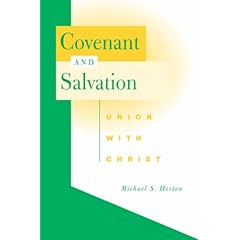 This is one of the most aware and hopeful accounts of Reformation Theology that the reader will ever see. It is incredibly relevant to the current world of theology. Horton begins with the presupposition not only that “the Reformation tradition” contains a huge amount of “unexploited potential” for engaging this current world, but that this potential is found within the framework of Covenant Theology.
 Horton traces the two covenants, “the covenant of Law,” given to (and broken by) both Adam and Israel, and the “covenant of Promise,” given to Noah, Abraham, David, and ultimately fulfilled in Christ. He distinguishes these two covenants, based on research done not only by Reformed biblical scholarship, but also “from Jewish and Roman Catholic traditions” (including the work of Cardinal Joseph Ratzinger) that has found two ancient kinds of covenants: a “suzerainty” treat, often given from a stronger king to a weaker king in the form, “do this and you will live,” and a covenant of Promise, given in the form of “a royal grant,” which took the form of “an outright gift of a king to a subject.”
“The covenant at Sinai certainly bears the marks of a suzerainty treaty. In fact, the exact form is followed in Exodus 19 and 20 as well as in Deuteronomy 5: Yahweh identifies himself as the suzerain (preamble), with a brief historical prologue citing his deliverance of the people from Egypt, followed by the Ten Commandments (stipulations), with clear warnings (sanctions) about violating the treaty to which they have sworn their allegiance.” (pg 13.)
The covenant with Noah, Abraham and David is given in “a completely different form,” a “one-sided promise on God’s part with no conditions attached (see Genesis 9). “The point is this: the deepest distinction in Scripture is not between the Old and New Testaments, but between the covenants of law and the covenants of promise that run through both” (pg 17, emphasis in original).
From this point, Horton engages all of the many theologies that are being presented today, beginning with the “New Perspective on Paul,” (the “covenant nomism” of which takes into account the covenant of Law, but not the covenant of Promise,” but along the way, he engages not only Sanders, Dunn and Wright, but also Rahner and Von Balthasar, Barth and Hunsigner, Milbank and Ward, Tillich, Moltmann, and a host of others. Along the way, Horton brings home with power and dignity the genius of the Reformers, and he shows how the genius of the Reformers is not only relevant in today’s thought climate, but ideal.
This is a thoughtful, erudite, and masterful work.
2008-01-17
Whose version of the Bible is right?
Catholic Bibles have 72 books as all good school children learned in my day. The Protestant Bibles have 66. Who's right? And who should we believe about who's right?
Consider this short snippet (it's about 6 minutes long, with a little bit of audio, and mostly some pretty music):
Consider this short snippet (it's about 6 minutes long, with a little bit of audio, and mostly some pretty music):
Clark's Review of "A Secular Faith"
"A Secular Faith: Why Christianity Favors the Separation of Church and State" by D.G. Hart -- a Review by R. Scott Clark
Permissions: You are permitted and encouraged to reproduce and distribute this material in any format provided that you do not alter the wording in any way, you do not charge a fee beyond the cost of reproduction, and you do not make more than 500 physical copies. For web posting, a link to this document on our website is preferred. Any exceptions to the above must be explicitly approved by Modern Reformation.
Evangelical involvement in politics has perhaps never been more intense. The Bush administration speaks of integrating faith and politics and has an office of faith-based initiatives. The national media cover the scandals of evangelical leaders because those evangelicals have political clout. Indeed, most Christians on the right and left seem to agree that there is such a thing as distinctly Christian politics. Into this super-heated environment comes a book by Darryl Hart challenging the assumptions that fuel the social programs of both conservative and liberal Christians.Modern Reformation magazine, March/April Vol. 16 No. 2 2007 Pages 49-51
Hart's argument with both groups is that "Christianity in its classic formulations, especially the Protestant traditions of Lutheran, Reformed, and Anglican, has very little to say about politics or the ordering of society" (10). "Christian-inspired policy arguments" or candidates are inappropriate "on Christian grounds" because "using Christianity for political ends fundamentally misconstrues the Christian religion" (253).
Through nine chapters, Hart interacts with a substantial body of literature attempting to account for the relations between Christ and Caesar. He argues that, when pressed into the service of Caesar, Christianity is always denatured and cheapened, because, the "trick of successfully employing any faith for public ends is to have access to the socially useful parts of religion while leaving behind its dogmatic and sectarian baggage" (13). For Hart, there is no such thing as "Christian" politics. For readers familiar with Hart's earlier work, this view should come as no surprise as it is part of his broader advocacy of the renewal and reapplication of the Reformation theory of the two kingdoms, that is, the notion that Christ is sovereign over all things but he administers his sovereignty in two distinct kingdoms: civil and ecclesiastical. Thus, nonecclesiastical vocations are common to believers and unbelievers and much of this common work must be conducted according to creational categories (nature) and existing cultural norms rather than redemptive categories (grace). In other words, there is no distinctly Christian way to drive a bus or set monetary policy. Bus drivers, historians, and politicians do common work according to nature. Hart, with a few other writers (such as David VanDrunen and Michael Horton), seeks to employ the two kingdoms theory in the late modern world as a bulwark against evangelical and liberal theocratic tendencies. According to Hart, both the evangelical right and the mainline left are theocratic. Walter Rauschenbusch's "social gospel" has become the playbook for ostensibly conservative evangelicals (105-123). Both the Christian left and right routinely misappropriate and misapply passages from the Old Testament-passages intended to speak to the Israelite theocracy and to the church-as if they were intended to serve as a blueprint for post-canonical social policy.
How are Christians to negotiate their civic lives? Hart's answer is that we must embrace an "awkward neutrality" (229-230), that we must be prepared to live "hyphenated lives." With "legal secularists," Hart argues that for Christian secularists, "the work of government lacks any overtly religious or spiritual purpose" (15). Its work is common to believer and unbeliever. In an age when the "integration" of faith and life is the standing order, it is bracing, even shocking to see one arguing that Christians should "bracket" their faith (175-177, 253, 257) from their civic lives.
He takes issue with the notion on which much Christian political involvement has been premised, , American exceptionalism, the notion that the United States is a "shining city on a hill" (19-45). Only the visible church could be that city in this world. Thus, he criticizes the colonial Puritans, mainline Christians, and evangelicals for consistently applying theocratic categories to the civil rather than to the ecclesiastical kingdom.
Following George Marsden's account of the influence of the "Whig cultural ideal" (54), Hart observes that Christians have regularly confused democratic republicanism with Christianity and vice versa, conflating Christian liberty with political liberty (66). He argues that the legal secularism of Isaac Kranmick and R. Laurence Moore is closer to the intent of the Westminster Divines than is modern Christian republicanism (69-71). He chronicles the consequences of this ideology for American Christianity by surveying the rise of the "common" (public) school. In order for such an institution to foster a generic civic religion, the common schools that arose in the 19th century had to promulgate a sub-Christian faith (89).
Drawing upon Nathan Hatch's analysis of the democratization of American Christianity, Hart also contends that much of what is done in the name of advancing the "kingdom of God" is really the product of Jacksonian, egalitarianism (124-152), and attempts to preserve the Protestant hegemony, on the flawed assumption that the Protestant churches are the seminary of democracy (145, 150-152).
One of the most interesting chapters is his survey of the changes in religious identity in America from Al Smith's defeat to today. John Kennedy had to assure evangelicals that he would not allow his Romanism to influence his policies and today evangelicals seem to insist that Roman politicians obey the Pope in their civil lives. In this chapter, Hart engages in his most detailed biblically based argument (170-174) for the two-kingdoms reading of Scripture.
Rejecting the dominant two-party reading of American religious history, that is, that there are two kinds of Christians ("conservative" and "liberal"), Hart argues that the conservatives of the National Association of Evangelicals are not really different from liberals of the National Council of Churches (chapter 7). Rather, genuine religious faith is bound not to produce a religious unity, as the Christian-republicans (right and left) imagine, but division. True religious conviction is inherently confessional and sectarian (206).
Like everything that Hart writes, this work is provocative in the best sense. As a Reformed confessionalist, I find his argument theologically compelling. The Israelite theocracy was unique and fulfilled by Christ. Christ and his apostles established an institution with only spiritual authority and commanded Christians to live peaceably and patiently in a hostile culture. Implicitly or explicitly, however, under the influence of pre- or post-millenarian eschatology (anticipating some earthly golden age) Christians have spent much of modernity trying to resuscitate Christendom by employing implicitly or explicitly theocratic arguments. Even if one disagrees with Hart's theology, anyone willing to reconsider the prevailing theology of cultural engagement will find a vigorous discussion partner here.
My agreement notwithstanding, Hart's rhetoric and historical analysis raise questions for further discussion. According to Hart, the adjective "public" refers to civic activities and the adjective "private" refers to sectarian ecclesiastical religious activities. [Certainly he is entitled to his definitions, and used to mean "not civic," Christian practice must be described as private. Yet some will wonder whether "private" is the best adjective to describe Christian theology and practice.] It's true that certain acts of piety are to be private (176) in the sense of "hidden from view" (Matt. 6:4), but the empty tomb was available for everyone to see, as was Christ's resurrected body and as is Christian worship.
Historians may balk at a few characterizations of seventeenth-century British politics and the political intentions of the Westminster Assembly (e.g., 64, 70). For example, though Hart concedes that the two kingdoms doctrine emerged under Christendom (i.e., a state-church, the civil enforcement of the first table of the Decalogue), his account of Westminster Confession of Faith chapter 20 makes no mention of the original version of Article 23, which calls for the magistrate to keep "unity and peace" in the church and to keep pure "the Truth of God" and to suppress "all blasphemies and heresies" (23.3).
Similarly, his claim that the Reformation marginalized the institutional church (244) is partly true, but a little misleading. He refers in passing to the consequence of desacralization of the world by the Reformation. Where the medieval church had grace "perfecting" nature, the Reformation restored nature and grace to their rightful places. For Protestants, grace renews nature. Did that make the church less or more important in the lives of believers?
One might also be puzzled by the relative absence of Calvin's theory of the two kingdoms in a book by a confessional Presbyterian. He spends several pages on Augustine's two cities and on Luther's theory of the two kingdoms but little on Calvin's theory of the two kingdoms, giving perhaps unintentionally the impression that his view is more Augustinian and Lutheran than Calvinist.
Finally, Hart's argument makes one eager for further elaboration of a positive basis on which Christians can make civil decisions. After all, through the ballot initiative and referendum process now commonplace, the average citizen is engaged in making policy on a level that pre-Enlightenment Christians could hardly imagine. Discussion of the historic Protestant doctrine of natural law will be most welcome. This is a valuable book deserving of careful attention from readers across the religious and theological continuum.
Permissions: You are permitted and encouraged to reproduce and distribute this material in any format provided that you do not alter the wording in any way, you do not charge a fee beyond the cost of reproduction, and you do not make more than 500 physical copies. For web posting, a link to this document on our website is preferred. Any exceptions to the above must be explicitly approved by Modern Reformation.
2008-01-13
Triablogue: Theology at sea
Triablogue: Theology at sea or, "How the Catholic Church's Foundations are Crumbling."
How the internet can break an impenetrable edifice
It turns out that even the Mafia is being "transformed" by the internet.
That's because so much of Catholic "authority" -- especially the papacy -- has been "built on sand." The internet -- representing a flood of information, including a way of disseminating more accurate information about the papacy's history -- is going to erode away the foundations of that house built on sand.
PALERMO, Sicily (Jan. 13) - When it came down to business, Cosa Nostra could always count on fear. No more. In a rebellion shaking the Sicilian Mafia to its centuries-old roots, businesses are joining forces in refusing to submit to demands for protection money called "pizzo."The concept is different, but I think that the fear which held much of Catholicism in place -- the mystique of their authority -- is likewise being dissipated by people who are no longer dependent largely on their parish priests to get a handle on what their Church really teaches.
And they're getting away with it, threatening to sap an already weakened crime syndicate of one of its steadiest sources of revenue. The Mafia has a history of bouncing back from defeat, but this time it is up against something entirely new: a Web site where businessmen are finding safety in numbers to say no to the mob.
At the same time, businessmen ranging from neighborhood shopkeepers to industrialists are being emboldened by arrests of fugitive bosses, and the discovery in raids of meticulous Mafia bookkeeping on who paid the "pizzo" and how much.
"This rebellion goes to the heart of the Mafia," said Palermo prosecutor Maurizio De Lucia, who has investigated extortion cases for years. "If it works, we will have a great advantage in the fight against the Mafia."
These latest gains build on other successes in the fight to break Cosa Nostra's stranglehold on Sicily. In the last two decades, the syndicate has been battered by testimony from turncoats, who helped send hundreds of mobsters to prison in the late 1980s, and a fierce state crackdown a decade later after bombs killed two Palermo anti-Mafia prosecutors.
The number of rebels on the Web site is still tiny compared to Palermo's businesses overall, but their movement has helped to chip away at the Mafia's psychological hold on Sicilians - long conditioned to believe that defiance would bring ruin or a death sentence. And any consistent crumbling of that culture of fear could ultimately lead to Cosa Nostra's undoing.
That's because so much of Catholic "authority" -- especially the papacy -- has been "built on sand." The internet -- representing a flood of information, including a way of disseminating more accurate information about the papacy's history -- is going to erode away the foundations of that house built on sand.
2008-01-06
Why the Reformation will Succeed Today
As I read the history of the Reformation, little by little, it occurs to me that the ideas and ideals of the Reformation will be more relevant and more successful in our time than in the time when they were first espoused. Today's Protestant churches seem to be wandering in a lot of different directions. The Reformation will enable Protestants, by the mere discussion of its ideals, to be able to re-focus on what is really important in their heritage.
As well, today's Catholic Church is seeking desperately to keep its hold on "the Faithful," but the things which are distinctively Catholic (as opposed to what is genuinely Christian in that religion) will be seen to be more and more bankrupt as more people begin to understand what the Reformation was all about.
Why do I say that? Because in the 16th century, even though ideas could spread via printing and the printing press, there was a mighty and unjust response from the "Catholic Reformation," which I've written about elsewhere, which included such things as repression and persecution and even "wars of religion." Such things are not likely to happen today. The main "religious" responses to the Protestant Reformers came in the form of the Jesuits and their casuistry, (and a blind devotion to the papacy that mandated "the white which I see, is black, if the Hierarchical Church so decides it." In today's internet-connected world, people today are more bound to require to "be convinced by Scripture and reason," and thus, Catholicism will be forced to defend its ideas on their own strength, not with a sword.
And the Catholic response to the Reformation was the Council of Trent,
As well, today's Catholic Church is seeking desperately to keep its hold on "the Faithful," but the things which are distinctively Catholic (as opposed to what is genuinely Christian in that religion) will be seen to be more and more bankrupt as more people begin to understand what the Reformation was all about.
Why do I say that? Because in the 16th century, even though ideas could spread via printing and the printing press, there was a mighty and unjust response from the "Catholic Reformation," which I've written about elsewhere, which included such things as repression and persecution and even "wars of religion." Such things are not likely to happen today. The main "religious" responses to the Protestant Reformers came in the form of the Jesuits and their casuistry, (and a blind devotion to the papacy that mandated "the white which I see, is black, if the Hierarchical Church so decides it." In today's internet-connected world, people today are more bound to require to "be convinced by Scripture and reason," and thus, Catholicism will be forced to defend its ideas on their own strength, not with a sword.
And the Catholic response to the Reformation was the Council of Trent,
which declared its mind, after much heart-searching, on the matter of justification: a decree of sixteen chapters with thirty-three canons attached. Canon Nine reads: "If anyone saith that by faith alone the impious is justified ... let him be anathema." It was entirely due to Luther that Catholicism was now defined in relation to that Doctrine! (Patrick Collinson, "The Reformation: A History," pg 113)
2007-12-22
John Calvin’s Influence in the Church and the World
In selecting the Reformation period as the focus of my effort, I am attracted by such summaries as this overview of what John Calvin and his associates were able to accomplish in the city of Geneva during the mid 1550’s. Remember that this was the time during which the Roman Catholic Church was instituting a period of great repression.
* * * * *
The following is taken from Robert Reymond’s “John Calvin: His Life and Influence” ©2004 Robert Reymond, Christian Focus Publications, Ross-Shire, England, pgs 74 ff.
Calvin’s “second Geneva period” (1541-1564) has been generally divided by his biographers and church historians into two distinct periods: his years of struggle (1541-1555), about which we will say something, in which he was often at odds with the Little Council and with his religious enemies, and his years of triumph (1555-1564). Here again, we witness the Genevan motto, Post Tenebras Lux, being exhibited. Much could be said about Calvin’s ministry during the last nine years of his life when he was finally able to see his concern for a free church in Geneva approved by the Little Council[i] and his energies directed to his writings and to the evangelization of France. But we may summarize his accomplishments during this “Second Geneva Period” by highlighting the following eight categories of activity that he accomplished with eh aid and cooperation of a close band of like-minded ministerial colleagues (“the Venerable Company”), all of whom like himself were exiles from France, and the Consistory a new institution made up of an equal number of ministers and magistrates sitting as elders, that met on a regular basis to supervise the morals and religious life of the community:
Calvin finally saw founded in Geneva, not a new state, but a new church[ii]—the Protestant church. I will explain what I mean here. Abraham Kuyper observes:
…when the question is put, Who had the clearest insight into the reformatory principle, worked it out most fully, and applied it most broadly, history points to the Thinker of Geneva and not to the Hero of Wittenberg. …in all Lutheran countries [following the principle of Luther and the Lutheran jurists: Cuius region eius religio (“Whose the region, his the religion”)] the Reformation originated from the princes rather than from the people, and thereby passed under the power of the magistrate, who took his stand in the Church officially as her highest Bishop, and therefore was unable to change either the social or the political life in accordance with its principles.
Calvin’s “ideal of a Church, not independent of the State, but autonomous and free to act in its own sphere, came into conflict at every instant with the strict dependency to which the German Churches were subjected by the political power.” Consequently, the churches following Calvin’s lead in Switzerland, the Netherlands, England, Scotland, and Colonial America—fearing with Calvin the “annexation of the church by the state, a secularization of [its] theology for the benefit of political ideology, [and] the dilution, finally, of the ecclesiastical dignity within the civil hierarchy”—insisted upon freedom from the powers of the magistrate insisted upon freedom from the powers of the magistrate in order to govern themselves, thereby creating the Protestant Church. And these Calvinistic churches:
* * * * *
In all, Reymond noted that there were eight accomplishments, and I have noted the first two of those here. It’s true that these were largely political accomplishments. But given the atmosphere at the time, and how both the papacy and secular kings sought each to dominate the other, and to meddle in the affairs of others, this “separation” by Calvin at Geneva was a remarkable concept in the history of the church.
This “separation” of the church from under the influence of the government, while enabling Christians to influence the governments of the time, also enabled the church truly to be the church in the world.
Other accomplishments included:
* The Geneva Bible in its (original) French translation
* Missionaries to France, and the growth of the French Protestant Churches to a membership of more than two million people
* The Geneva Academy, which became the first Protestant “university”
* More than 4,000 sermons
* Commentaries on most of the Bible, plus three catechisms, several confessions of faith, and many theological treatises
* The Institutes of the Christian Religion
All of these accomplishments helped to generate the “mighty impulse to every forward movement, and made Protestantism the chief propelling force in the history of modern civilization” that Philip Schaff wrote about in his History of the Christian Church.
It is not my contention that “we need another Reformation”. It is my contention that by remembering the original Reformation, that Protestant Christians can:
* Find a point of unity in seeing a common heritage in the theological abuses that the original Reformers sought to reform
* Open a discussion about what the church truly can be in the world, and the great things that Christ has accomplished through a faithful church
* Gain a better understanding of their place in history today
* Give an impulse to the forward movements of our day
No doubt, some will point to the corruptions that have happened among the Protestant churches in light of things like the development of Arminianism, American revivalism, theological liberalism, and other ills. None of these developments, though, should take away the absolute courage and devotion to Christ and the overall success that Calvin and his associates exhibited, which mightily changed the course of history.
--------------------------------------------------------------------------------
Footnotes:
[i] “A brief word about Geneva’s government structure at this juncture may be helpful. At the head of the city’s government was the twenty-five-man Little Council, composed of four powerful magistrates or mayors known as the Syndics, the city treasurer, and twenty others. The Council of the Two Hundred, established in 1527, and elected by the Little Council, somewhat strangely elected in turn those sitting on the Little Council. Between these two Councils was the rather useless Council of the Sixty … whose function was mainly diplomatic … Any business went first to the Little Council, then to the Council of the Two Hundred. A fourth council—the General Council composed of all the heads of households in Geneva—played a more tenuous role; in Calvin’s time it met twice annually: in February to elect the four Syndics and in November to set corn and wine prices. This little arrangement appears to be somewhat cumbersome, but the Little Council members, sitting three times a week, actually wielded the greatest power and in fact ran the city government. So, in sum, that was the magisterial system with which Calvin worked throughout his years at Geneva.” Reymond, pgs 58-59.
[ii] “The central issue that brought this about, as we have suggested, was Calvin’s years-long concern to achieve for the church freedom from the state in ecclesiastical disciplinary matters.” Reymond, pg 75. Again, keep in mind that Rome’s Inquisition was still very much in effect at this time.
* * * * *
The following is taken from Robert Reymond’s “John Calvin: His Life and Influence” ©2004 Robert Reymond, Christian Focus Publications, Ross-Shire, England, pgs 74 ff.
Calvin’s “second Geneva period” (1541-1564) has been generally divided by his biographers and church historians into two distinct periods: his years of struggle (1541-1555), about which we will say something, in which he was often at odds with the Little Council and with his religious enemies, and his years of triumph (1555-1564). Here again, we witness the Genevan motto, Post Tenebras Lux, being exhibited. Much could be said about Calvin’s ministry during the last nine years of his life when he was finally able to see his concern for a free church in Geneva approved by the Little Council[i] and his energies directed to his writings and to the evangelization of France. But we may summarize his accomplishments during this “Second Geneva Period” by highlighting the following eight categories of activity that he accomplished with eh aid and cooperation of a close band of like-minded ministerial colleagues (“the Venerable Company”), all of whom like himself were exiles from France, and the Consistory a new institution made up of an equal number of ministers and magistrates sitting as elders, that met on a regular basis to supervise the morals and religious life of the community:
As a result of the struggles and labors of Calvin and the other Geneva ministers the city’s moral and social bearing gradually improved, which influenced many other cities in Europe and saw Geneva as attempting to live out the principles of religious reform. For these cities, Geneva, emerging as the major powerhouse of religious and cultural reform, became a beacon of hope in an unruly world, so much so that John Knox who studied under Calvin there would later characterize it as “the most perfect school of Christ that ever was on the earth since the days of the Apostles.” Because of Geneva’s reforming efforts, “the moralizing of social life, the work ethic, the prohibition of begging, aid to the poor—these [became] some distinguishing traits of the Calvinistic city.
Calvin finally saw founded in Geneva, not a new state, but a new church[ii]—the Protestant church. I will explain what I mean here. Abraham Kuyper observes:
…when the question is put, Who had the clearest insight into the reformatory principle, worked it out most fully, and applied it most broadly, history points to the Thinker of Geneva and not to the Hero of Wittenberg. …in all Lutheran countries [following the principle of Luther and the Lutheran jurists: Cuius region eius religio (“Whose the region, his the religion”)] the Reformation originated from the princes rather than from the people, and thereby passed under the power of the magistrate, who took his stand in the Church officially as her highest Bishop, and therefore was unable to change either the social or the political life in accordance with its principles.
Calvin’s “ideal of a Church, not independent of the State, but autonomous and free to act in its own sphere, came into conflict at every instant with the strict dependency to which the German Churches were subjected by the political power.” Consequently, the churches following Calvin’s lead in Switzerland, the Netherlands, England, Scotland, and Colonial America—fearing with Calvin the “annexation of the church by the state, a secularization of [its] theology for the benefit of political ideology, [and] the dilution, finally, of the ecclesiastical dignity within the civil hierarchy”—insisted upon freedom from the powers of the magistrate insisted upon freedom from the powers of the magistrate in order to govern themselves, thereby creating the Protestant Church. And these Calvinistic churches:
Have always struggled…for the liberty, that is to say, for the sovereignty of the Church, within her own sphere, in distinction from the Lutheran theologians. In Christ, they contended, the Church has her own King. Her position in the State is not assigned her by the permission of the Government, but jure divino. She has her own organization. She possesses her own office-bearers. And in a similar way she has her own gifts to distinguish truth from the lie. It is therefore her privilege, and not that of the State, to determine her own characteristics as the true Church, and to proclaim her own confession as the confession of the truth.With all this Benjamin B. Warfield concurs. Accordingly, he concludes:
…every Church in Protestant Christendom which enjoys today any liberty whatever, in performing its functions as a Church of Jesus Christ, owes it all to John Calvin. It was he who first asserted this liberty in his early manhood…; it was he who taught his followers to value it above life itself, and to secure it to their successors with the outpouring of their blood. And thus Calvin’s great figure rises before us as not only in a true sense the creator of the Protestant Church, but the author of all the freedom it exercises in its spiritual sphere.
* * * * *
In all, Reymond noted that there were eight accomplishments, and I have noted the first two of those here. It’s true that these were largely political accomplishments. But given the atmosphere at the time, and how both the papacy and secular kings sought each to dominate the other, and to meddle in the affairs of others, this “separation” by Calvin at Geneva was a remarkable concept in the history of the church.
This “separation” of the church from under the influence of the government, while enabling Christians to influence the governments of the time, also enabled the church truly to be the church in the world.
Other accomplishments included:
* The Geneva Bible in its (original) French translation
* Missionaries to France, and the growth of the French Protestant Churches to a membership of more than two million people
* The Geneva Academy, which became the first Protestant “university”
* More than 4,000 sermons
* Commentaries on most of the Bible, plus three catechisms, several confessions of faith, and many theological treatises
* The Institutes of the Christian Religion
All of these accomplishments helped to generate the “mighty impulse to every forward movement, and made Protestantism the chief propelling force in the history of modern civilization” that Philip Schaff wrote about in his History of the Christian Church.
It is not my contention that “we need another Reformation”. It is my contention that by remembering the original Reformation, that Protestant Christians can:
* Find a point of unity in seeing a common heritage in the theological abuses that the original Reformers sought to reform
* Open a discussion about what the church truly can be in the world, and the great things that Christ has accomplished through a faithful church
* Gain a better understanding of their place in history today
* Give an impulse to the forward movements of our day
No doubt, some will point to the corruptions that have happened among the Protestant churches in light of things like the development of Arminianism, American revivalism, theological liberalism, and other ills. None of these developments, though, should take away the absolute courage and devotion to Christ and the overall success that Calvin and his associates exhibited, which mightily changed the course of history.
--------------------------------------------------------------------------------
Footnotes:
[i] “A brief word about Geneva’s government structure at this juncture may be helpful. At the head of the city’s government was the twenty-five-man Little Council, composed of four powerful magistrates or mayors known as the Syndics, the city treasurer, and twenty others. The Council of the Two Hundred, established in 1527, and elected by the Little Council, somewhat strangely elected in turn those sitting on the Little Council. Between these two Councils was the rather useless Council of the Sixty … whose function was mainly diplomatic … Any business went first to the Little Council, then to the Council of the Two Hundred. A fourth council—the General Council composed of all the heads of households in Geneva—played a more tenuous role; in Calvin’s time it met twice annually: in February to elect the four Syndics and in November to set corn and wine prices. This little arrangement appears to be somewhat cumbersome, but the Little Council members, sitting three times a week, actually wielded the greatest power and in fact ran the city government. So, in sum, that was the magisterial system with which Calvin worked throughout his years at Geneva.” Reymond, pgs 58-59.
[ii] “The central issue that brought this about, as we have suggested, was Calvin’s years-long concern to achieve for the church freedom from the state in ecclesiastical disciplinary matters.” Reymond, pg 75. Again, keep in mind that Rome’s Inquisition was still very much in effect at this time.
2007-12-02
The Spirit of Catholicism
In 1543 a little book was published in Venice with the title Trattato utilissimo del beneficio di Giesu Christo crocifisso i cristiani (A Most Useful Treatise on the Merits of Jesus Christ Crucified for Christians), written by an elusive Benedictine monk called Benedetto da Mantova (dates of birth and death unknown, but his surname seems to have been fontanino) with some help from the humanist and poet Marcantonio Flaminio (1498-1550), a popular work of piety that was translated into several languages including Croat. At first sight this may appear to be a piece of native Italian Christocentrism, part of a Pauline and Augustinian renaissance known to have been nourished by a Spanish humanist and biblicist, Juan de Valdes (1500-1541), whose pious circle in Naples had included Flaminio. But the Beneficio can be read in more than one way. It proves to have been made up from a number of transalpine Protestant texts, and especially the 1539 edition of Calvin's Institutes. Whether or not Benedetto had come across Calvin in his monastery on the slopes of Mount Etna, which seems unlikely, the Institutes was known to Flaminio.
It is hard to distinguish between the theology of the Beneficio and Protestantism. "Man can never do good works unless he first know himself to be justified by faith." Other scholars insist, however, that the Beneficio is an expression of Evangelism, a movement that was not generated by Protestantism and should be distingueshed from it. What is certain is that the Beneficio was placed on the Index and so successfuly repressed by the Roman Inquisition that of the many thousands of copies of the Italian edition that were once in existence only one is known to survive, discovered in the library of a Cambridge college in the nineteenth century. That sort of successful repression was the Counter-Reformation. (The Reformation, a History, Patrick Collinson, (c)2003, pgs 105-106.)
Subscribe to:
Posts (Atom)